• Menu
  • Skip to primary navigation
  • Skip to main content
  • Skip to primary sidebar

cothrive.earth

  • Home
  • About
  • Blog
  • Essays
  • Subscribe
  • Donate
  • Contact
  • Home
  • About
  • Blog
  • Essays
  • Subscribe
  • Donate
  • Contact

Blog

Tilting at Windmills

November 7, 2025 By //  by cothrivejs

“Somebody needs to do something—it’s just incredibly pathetic that it has to be us.”
– Jerry Garcia (1988), on the Grateful Dead’s support for efforts to save the world’s rain forests

Hello, and happy November 7!

Today is my sister’s birthday – the happiest of birthdays, Anne! I’m so glad you were born!

Today also marks day 37 of the federal government shutdown, the longest such shutdown in history. According to Wikipedia, the previous record-holder was the most recent: The 2018-19 shutdown lasted 35 days and cost the federal government $5 billion. Having no end in sight, this one will likely cost much more.

To what end?

I don’t know, and I’m guessing you don’t either. Just like with the DOGE debacle, no one in Washington is ground-truthing the real-life consequences of the government shutdown. There, people bloviate. Here, people bleed.

This is my ground-truth: Thanks to the shutdown, Jackson Hole is suffering. Our public lands. Our people. My friends, neighbors, and constituents.

Some folks are suffering directly, because they’re furloughed or working without pay. Others are suffering indirectly because of how the shutdown’s many ripple effects are washing over them.

Putting on my local government hat, there’s yet another rotten element to all this – its “pox on all your houses” effect. Even though state and local governments are fully operational, the federal shutdown is making all levels of government look bad. Which, in turn, makes things harder for all levels of public servants.

Again, to what end?

In the face of such idiocy, I feel compelled to do something. But what?

If I’m to be clear-eyed about my position, there’s not much I can do. Specifically, I am one member of a five-person governing body. Collectively, we oversee a city of 10,000 people in the least populous, most-libertarian state in the union. Add all that together and it doesn’t amount to a hill of beans in this crazy world.

But damn it, people are hurting. My constituents are hurting. My community is hurting. My country is hurting. And while I may not have much power, it’s more than most people have.

Hence the Jerry quote – while somebody needs to do something, it just feels incredibly pathetic it has to be me.

So, as pathetic as it seems, I’ve done what I can. And that forms the basis of this newsletter.

Specifically, we are now in week six of the shutdown. Since early October, I’ve marked the start of each new week by writing a letter to a group of federal government leaders whose decisions affect Jackson Hole:

  • Wyoming US Senator John Barrasso
  • Wyoming US Senator Cynthia Lummis
  • Wyoming Representative Harriet Hageman
  • US Department of Agriculture Secretary Brooke Rollins
    • The US Forest Service is part of the Department of Agriculture, and parts of three national forests are in Teton County
  • US Department of Interior Secretary Doug Burgum
    • The National Park Service and US Fish & Wildlife Service are both part of the Department of Interior, and both have properties within Teton County (Grand Teton and Yellowstone national parks, and the National Elk Refuge)
  • National Park Service Acting Director Jessica Bowron
  • US Forest Service Chief Tom Schultz
  • US Fish & Wildlife Service Director Brian Nesvik

My four October letters became official Town of Jackson documents, approved by the town council and signed by the mayor. When the mayor and council demurred from sending letters during the first two weeks of November, I sent them personally.

I’ll keep sending a letter each week until the shutdown ends. Will it make any difference? Almost certainly not. Will it make me feel better? Absolutely. Not just because sending these letters makes me feel like I’m doing something, but because the letters channel sentiments I’m hearing from so many other folks, every last one of them appalled by what’s going on in Washington.

Below are the basic drafts of the six letters I’ve written. The first four were slightly altered before they were sent, reflecting the fact they became official town documents signed by Mayor Arne Jorgensen. The two November letters are as I sent them directly (if the shutdown ends before November 12, I’ll not send number six).

Because I used a similar format for all six letters, there’s some repetition between them. To make it easier for readers, I’ve italicized the portions which echo earlier letters. The portions in regular type are fresh to that letter.

  • October 8, 2025
  • October 15, 2025
  • October 22, 2025
  • October 29, 2025
  • November 5, 2025
  • November 12, 2025

As always, thank you for your interest and support.

Jonathan Schechter
Executive Director


PS – In my September 24, 2025 CoThrive, I posed five questions which I feel frame Jackson Hole’s future. As part of the Teton County Library’s “Swap Meet” series, I’ll be leading a discussion about the questions at the library this coming Thursday, November 13, from 7:00 – 8:30 pm. If you’re interested in joining the conversation, I’d love to see you there.

The questions are:

  • Our ecosystem: Is it still our priority?
  • Our character: What do we value?
  • Champagne tastes; beer budget: What is the proper role of government?
  • Subsidizing local business: Whom shall we house?
  • Gridlock: How much traffic are we willing to put up with?

October 8, 2025

Dear Leader,

As we enter the second week of the federal government shutdown. we write for two reasons:

  • To urge you to do all you can to reopen the federal government; and
  • To help you understand how the shutdown is affecting our community and our constituents

We, the undersigned, form the town council of Jackson, Wyoming. Within our community lies all of Grand Teton National Park, the southern half of Yellowstone National Park, the National Elk Refuge, and portions of three different national forests. Visitors come from around the world to visit these majestic federal lands, and the sales taxes they pay form a significant portion of the Town of Jackson’s annual budget (roughly 80% of the town’s operating revenue comes from sales taxes).

The link between the health of our ecosystem and the health of our community is so clear that, 13 years ago, the Jackson Town Council and our colleagues on the Teton County Commission codified it into the Vision Statement of our Joint Comprehensive Plan: “Preserve and protect the area’s ecosystem in order to ensure a healthy environment, community and economy for current and future generations.”

As elected officials, ensuring a healthy environment, community and economy is the essence of our job. Unfortunately, the federal government shutdown is making this job much harder.

In particular, history has shown that federal government closures – whether partial or total – puts the health of our public lands at risk. Sometimes these risks are direct (e.g., unscrupulous people damaging the lands, waters, and wildlife). Other times they are indirect (e.g., from needed work not getting done). Regardless, what’s clear is that closures cause both short- and long-term damage, which in turn compromises our region’s environment, community and economy.

The longer the closure goes on, the worse the problems will be for our environment, community and economy. Because you are the fiduciaries of the extraordinary asset that is our public lands, and because we are confident you share our goal of keeping the Town of Jackson and the greater Tetons region not just healthy but thriving, we urge you to do all you can to, at a minimum, fully open our national parks, forests, and wildlife refuges. Ideally, your efforts will help reopen the entire federal government.

Thank you for your consideration.

Very truly yours
Jackson Town Council

October 15, 2025

Dear Leader,

As we enter the third week of the federal government shutdown. we write for two reasons:

  • To urge you to do all you can to reopen the federal government; and
  • To help you understand how the shutdown is affecting our community and our constituents

We, the undersigned, form the town council of Jackson, Wyoming. Within our community lies all of Grand Teton National Park, the southern half of Yellowstone National Park, the National Elk Refuge, and portions of three different national forests. Visitors come from around the world to visit these majestic federal lands, and the sales taxes they pay form a significant portion of the Town of Jackson’s annual budget (roughly 80% of the town’s operating revenue comes from sales taxes).

In our most recent letter to you, we discussed the importance of our ecosystem’s health to our community. Today, we’d like to focus on how the federal government shutdown is harming our economy.

Historically, Jackson Hole has had strong summer and winter tourism economies, but relatively low visitation in the spring and fall. Over the last decade or so, the community has collectively addressed this imbalance, and our efforts are finally paying off. In particular, October visitation to Grand Teton National Park has grown faster than in any other month, driving a similar surge in taxable sales.

Unfortunately, every day the federal government is shut increases the risk to these hard-won gains. Even more unfortunately, this is true even for partial shutdowns. In particular, not only are we already seeing decreased visitation, but past government shutdowns have shown us that rebuilding visitation is a long and costly process.

The longer the closure goes on, the worse the problems will be for our environment, community and economy. Because you are the fiduciaries of the asset that is our public lands, and because we are confident you share our goal of keeping the Town of Jackson and the surround Tetons region not just healthy but thriving, we urge you to do all you can to, at a minimum, fully open our national parks, forests, and wildlife refuges. Ideally, your efforts will help reopen the entire federal government.

Thank you for your consideration.

Very truly yours
Jackson Town Council

October 22, 2025

Dear Leader,

As we enter the fourth week of the federal government shutdown. we write for two reasons:

  • To urge you to do all you can to reopen the federal government; and
  • To help you understand how the shutdown is affecting our community and our constituents

We, the undersigned, form the town council of Jackson, Wyoming. Within our community lies all of Grand Teton National Park, the southern half of Yellowstone National Park, the National Elk Refuge, and portions of three different national forests. Visitors come from around the world to visit these majestic federal lands, and the sales taxes they pay form a significant portion of the Town of Jackson’s annual budget (roughly 80% of the town’s operating revenue comes from sales taxes).

In our most recent letter to you, we discussed how the government shutdown is harming our region’s economy. Today, we’d like to discuss a much more personal issue: the effects the closure is having on the 400+ federal employees who live in Jackson Hole. These are our friends, neighbors, and constituents, and every passing day of closure makes their lives increasingly challenging.

Jackson Hole’s federal lands are the heart and soul of our region – ultimately, neither our economy nor community at large can be healthier than the lands surrounding us. As a result, the work Jackson Hole’s federal employees do is absolutely vital not just to our public lands, but to our economy and community.

While federal employees represent fewer than 2% of Jackson Hole’s workforce, their importance to our community’s well-being is inestimably greater. Every day our federal employees are not working increases the threats to everything that makes our community special.

At least as important is the human toll the shutdown is taking on these several hundred people and their families. We as a community are doing everything we can to help them, but even these efforts are a poor substitute for the pride and stability that come with a job.

The longer the closure goes on, the worse the problems will be for our environment, community and economy. Because you are the fiduciaries of our public lands, and because we are confident you share our goal of keeping the Town of Jackson and the surround Tetons region not just healthy but thriving, we urge you to do all you can to, at a minimum, fully open our national parks, forests, and wildlife refuges. Ideally, your efforts will help reopen the entire federal government.

Thank you for your consideration.

Very truly yours
Jackson Town Council

October 29, 2025

Dear Leader,

As we enter the fifth week of the federal government shutdown. we write for two reasons:

  • To urge you to do all you can to reopen the federal government; and
  • To help you understand how the shutdown is affecting our community and our constituents

We, the undersigned, form the town council of Jackson, Wyoming. Within our community lies all of Grand Teton National Park, the southern half of Yellowstone National Park, the National Elk Refuge, and portions of three different national forests. Visitors come from around the world to visit these majestic federal lands, and the sales taxes they pay form a significant portion of the Town of Jackson’s annual budget (roughly 80% of the town’s operating revenue comes from sales taxes).

In our most recent letter to you, we discussed how the government shutdown is harming our friends, neighbors, and constituents working for the federal government. Today, we’d like to pose a simple question to you: Will the federal government compensate the Jackson – our businesses, constituents, and the town itself – for the financial damage the shutdown is causing?

From 2019-2024, taxable sales generated in October by Jackson Hole’s tourism economy grew from $42 million to $68 million, an increase of over 60%. Those sales generated nearly $3 million in revenue for the state of Wyoming, and roughly $2 million for Jackson Hole’s local governments.

Before the shutdown began, Jackson Hole’s national park-related tourism spending was running nearly 6% ahead of 2024’s levels. Depending on how severe the government shutdown-related drops in tourism prove to be, in October alone the loss to Jackson Hole’s businesses could total millions of dollars; the loss to state and local government could end up in the hundreds of thousands.

These losses would be concerning at any time. They are especially concerning now, though, as evidence mounts that our economy is slowing down. The federal government closure is making this problem worse, and its repercussions will increasingly harm our ability to address the growing challenges facing our community and region.

To this end, we urge you not only to do all you can to end the shutdown, but to make sure any plan for ending it compensates local businesses and governments for closure-related losses.

Thank you for your consideration.

Very truly yours
Jackson Town Council

November 5, 2025

Dear Leader,

I serve on the Jackson, Wyoming Town Council, though in this letter I speak just for myself.

Today marks the beginning of the sixth week of the federal government shutdown. Sadly, today also sets the record for longest-ever federal government shutdown. In that context, I write for two reasons:

  • To urge you to do all you can to reopen the federal government; and
  • To help you understand how the shutdown is affecting our community and our constituents

As you know, within Jackson Hole lies all of Grand Teton National Park, the southern half of Yellowstone National Park, the National Elk Refuge, and portions of three different national forests. Visitors come from around the world to visit these majestic federal lands, and the sales taxes they pay form a significant portion of the Town of Jackson’s annual budget (roughly 80% of the town’s operating revenue comes from sales taxes).

In an October 29 letter to you, the Jackson Town Council formally asked how the federal government plans to make whole the Jackson Hole businesses, local governments, and federal employees and contractors who have been financially harmed by the government shutdown. The pain everyone is feeling is real, and it’s only getting worse.

In this letter, I would like to build on that question by making a simple and related point: As is true for communities across the country, the shutdown is essentially an unfunded federal government mandate on Jackson Hole – its people, its businesses, and its local governments.

As you know the fundamental role of local government is to protect the health, safety, and welfare of our residents, businesses, and visitors. Right now, the federal government shutdown is making that task increasingly difficult.

To address these challenges, all aspects of the Jackson Hole community are stepping up, offering food, funds, and other assistance to the growing number of people – our friends, neighbors, and constituents – affected by the shutdown. This is who we are; this is what we do.

At the end of the day, though, the Jackson Hole community shouldn’t have to be doing this work. Why? Because we didn’t create these problems. Instead, the responsibility for them lies solely with the federal government, which you serve as a fiduciary.

Particularly troubling is the fact that, while the federal government is causing these problems, the federal government isn’t taking responsibility for its actions. Financially, logistically, politically – in all these ways and more, the federal government has created problems it’s forcing other agencies and people to address.

At the local level, my town council colleagues and I couldn’t get away with such a lack of accountability. I have to believe the same is true at the federal level. Nonetheless, it’s happening, and in so doing causing increasing problems for Jackson’s residents, businesses, and visitors. In other words, causing increasing problems for both my constituents and yours.

Unfortunately, the longer the shutdown drags on, the greater challenges become for all of us. To this end, I urge you to do all you can to end the shutdown, and to do so as soon as possible.

Thank you for your consideration.

Very truly yours,
Jonathan Schechter
Council member, Town of Jackson WY

November 12, 2025

Dear Leader,

I serve on the Jackson, Wyoming Town Council. In this letter, though, I speak just for myself.

As we enter the seventh week of the federal government shutdown. I write for two reasons:

  • To urge you to do all you can to reopen the federal government as quickly as possible; and
  • To help you understand how the shutdown is affecting my community and the constituents both you and I share.

As you know, within Jackson Hole lies all of Grand Teton National Park, the southern half of Yellowstone National Park, the National Elk Refuge, and portions of three different national forests. Visitors come from around the world to visit these majestic federal lands, and the sales taxes they pay form a significant portion of the Town of Jackson’s annual budget (roughly 80% of the town’s operating revenue comes from sales taxes).

On November 5, I wrote you making the observation that the federal government shutdown is essentially an unfunded federal government mandate on Jackson Hole and Jackson’s government. Today, I want to discuss some of the potential long-term consequences the shutdown is having on Jackson Hole’s economy.

As you know, tourism is the foundation of Jackson Hole’s economy, accounting for a large portion of our jobs, local government revenues, and community vitality.

Given the splendor of the region’s public lands, the fact Jackson Hole has a strong tourism economy may seem like a no-brainer. In fact, though, it’s the result of a tremendous amount of hard work and exceptional cooperation between our region’s public land managers, the Jackson Hole community, and the state of Wyoming.

Specifically, over the past couple of decades, local government and business leaders have been working closely with our national park superintendents, forest supervisors, and state tourism leaders to craft and execute a sustainable tourism strategy, one that balances the need to protect our lands while allowing millions of visitors annually to enjoy their grandeur.

And our efforts have worked! For example, between 1994-2004, visitation to Grand Teton National Park declined 10%; between 2004-2014, visitation increased 18%; and between 2014-2024, visitation increased 30%.

One vital component of this success is the work put in by park and forest officials during the non-summer months. The longer the federal government stays closed, the less of this work gets done, and the harder it becomes for us to continue our success into the future.

In short, the shutdown is putting decades of progress at risk, which is both a true tragedy and a preventable one. To this end, I urge you to do all you can to end the shutdown, and do it as soon as possible.

Thank you for your consideration.

Very truly yours,
Jonathan Schechter
Council member, Town of Jackson WY

My dog and her siblings celebrate turning two years old
(mom is the brown one)

Filed Under: Uncategorized

Champagne Tastes; Beer Budget

October 30, 2025 By //  by cothrivejs

Hello, and happy Halloween Eve!

A phrase gaining traction in Jackson Hole is “Angry August.” It describes that final stretch of summer when everything feels, well, stretched. Schedules, patience, tempers – the whole lot.

Perhaps because we are living in such fraught times, this year’s Angry August seems to have extended into Angry Autumn, a phenomenon I recently experienced first-hand.

When making a left turn at a four-way stop, I nearly hit a car that pulled out right in front of me. Unnerved, I laid on the horn. In response, I was greeted by both a middle-finger salute and a stream of profanities stretching from the other car to mine.

Moments later, the other driver pulled over, glared daggers at me, and continued to gesture and yell. He then pulled in behind me – so close I expected to be rammed – all the while keeping up his salute and leather-lunged vitriol.

This continued as I worked my way down the road. While the gestures and profanities may have entertained folks walking on the street, they caused me increasing concern. Finally, and after what seemed like forever, my new friend made a U turn and delivered his rhetorical coup de grace: “**** you, you ****ing piece of **** liberal.”

Reflecting on the incident, I had three reactions.

First, the other driver was apparently having a very bad day.

Second, I can only dream of having my voice carry so well that it can be heard by the driver of the car ahead of me.

Third, I had no idea I was a liberal.

I grew up in a politically-involved family. Both of my parents were what might be termed “Rockefeller Republicans,” leaning liberal on social issues and conservative on financial ones. Under our parents’ tutelage, my sister, brother, and I learned to love our country, its institutions, and its ideals. We also learned to seek and value both education and truth.

If, as the wags note, facts have a liberal bias, then I suppose I am a liberal – I do, after all, use facts as the foundation of this newsletter. But does a liberal oppose tax increases or look to cut government budgets? As you’ll read below, that’s my current m.o.

More importantly, do labels really matter?

All this was on my mind recently when I wrote the memo that, slightly modified, forms the basis of today’s newsletter. Directed to my fellow Jackson town councilmembers, the town’s senior staff, and my colleagues on the Teton County Commission, I wrote the memo in response to discussions the council is having about the future of the town’s budget, in particular the fact that, over the past few years, the town’s expenses have grown more rapidly than our revenues.

How best to address this problem? To me, the answer is clear. We need to spend the next couple of years focusing on reducing expenses, which in turn will give us the credibility to pose to voters the question dictated by our budget math: Do you want higher taxes or fewer services?

As always, thank you for your interest and support.

Jonathan Schechter
Executive Director


PS – The memo below was aimed at folks who understand local government finances pretty well. If you’re not in that camp, at the end of the essay you’ll find a “Local Government Funding Primer.”

PPS – I wish I could write well enough to capture the awe and gratitude I feel towards Mr. and Mrs. Old Bill, the Community Foundation of Jackson Hole, and all those who help make Old Bill’s Fun Run a reality. Simply put, because of you Jackson Hole is a immeasurably better place for all of us. Please accept my deepest and most heartfelt thanks.

PPPS – In my September 24, 2025 CoThrive, I posed five questions which I feel frame Jackson Hole’s future. As part of the Teton County Library’s “Swap Meet” series, I’ll be leading a discussion about the questions at the library on Thursday, November 13, from 7:00 – 8:30 pm. If you’re interested in joining the conversation, I’d love to see you there.

The questions are:

  1. Our ecosystem: Is it still our priority?
  2. Our character: What do we value?
  3. Champagne tastes; beer budget: What is the proper role of government?
  4. Subsidizing local business: Whom shall we house?
  5. Gridlock: How much traffic are we willing to put up with?
Old Bill’s Fun Run:
29 years; over $300 million raised

Introduction

When it comes to the town’s financial future and, in particular, raising revenues, my thinking is shaped by four beliefs and two facts.

Belief 1: Local government uses money efficiently, wisely, and well.

Belief 2: Local government needs more money.

Belief 3: The best way for local government to get more money is through a 7th cent of general revenue sales tax.

Two reasons:

  • The general revenue 7th cent comes without any strings attached; and
  • The general revenue 7th cent would raise far more money than any other revenue tool we have.
    • If the general revenue 7th cent were in place this year, it would have raised roughly $11.3 million for the town. In contrast, maxing out property taxes would have raised $6.4 million, and maxing out the lodging tax $1.9 million.

Belief 4: Enacting the 7th cent requires voter support. Unfortunately, if the vote were held today, the tax would lose because voters don’t trust government.

The same logic applies to the lodging tax.

Fact 1: The first time it will be possible to enact a 7th cent of general revenue sales tax is 2028, when the current Justice Center SPET will be fulfilled.

Fact 2: I’ve never lost an election. If we go for a 7th cent in 2028, I don’t want to lose that one either.

Given all this, I feel strongly that, over the next three years, everything we do should be oriented towards winning a 2028 vote for a 7th cent of general revenue sales tax. In particular, starting now, before taking any action we should ask ourselves: “How will this affect the 2028 7th cent vote?”

Put another way, I feel we need to spend the next three years earning voters’ trust in government. How? By taking three basic steps.

Step 1: Local government needs to spend the next few budget cycles taking a hard look at its expenses.

Step 2: Local government needs to make sure voters understand it is taking a hard look at its expenses.

Step 3: Local government can’t ask for any new money before 2028.

Why refuse to ask for any new money? Because doing so before 2028 will reenforce voters’ concerns that local government cares more about revenues than expenses. In turn, that will make voters even more suspicious of government, thereby making it even harder to pass the 7th cent.

Here’s how my thinking applies to the two major budget issues we’re currently considering.

Autumn palette I

Lodging Tax

I oppose putting a lodging tax on the November 2026 ballot. Why? For three reasons.

First, no natural constituency supports it. There are, however, large numbers of voters with deep concerns about our growing numbers of tourists. As a result, the measure’s opponents will have an easy time mustering “no” votes by pointing out that 60% of the proceeds must be spent on tourism promotion.

Second, because the lodging tax’s politics are so difficult, the only way it can win is by receiving the active, full-throated support of the tourism industry. Unfortunately, the tax doesn’t have this support. Nor will it: No tourism industry leader I know supports increasing the lodging tax, and many oppose it.

Third, if the lodging tax loses in 2026, its defeat would further sour voters towards local government, making it that much harder to pass the 7th cent of general revenue in November 2028.

Town of Jackson FY27 and FY28 budgets

In FY26, the town is budgeted to collect $36.3 million in revenues and spend $39 million, a shortfall of $2.7 million. At year’s end, this will leave a general fund balance of $15.5 million, 40% of our expenses.

Over the last several years, the general fund balance has grown because the town has taken in far more than it has spent. As a result, I’m okay with the FY26 shortfall, particularly because our year-end 40% general fund balance will be well above our 25% target.

For the same reasons, for FY27 I can support a budget that spends up to $1 million more than we anticipate collecting. Starting in FY28, though, the only budget I will support is one that breaks even or has a surplus.

In short, over the next two fiscal years I want the town to cut roughly $2 million in expenses.

This is “Step 1” of my three basic steps above: “Local government needs to spend the next few years taking a hard look at its expenses.”

Where would I make those cuts? I have no idea, so I wouldn’t try. Instead, I’d direct staff to identify potential cuts and bring various options back to the council. I’d take this approach because the town’s budget is so complex and tightly knit that identifying where and how to make thoughtful cuts requires skills and knowledge that staff has, and council doesn’t.

As we take Step 1, we also need to publicize what we’re doing; i.e., we need to take Step 2: “Local government needs to make sure voters understand it is taking a hard look at its expenses.”

Autumn palette II

Conclusion

In summary, for the next several years all of my budget-related thinking will be targeted towards winning voter approval of a 7th cent of general revenue sales tax in 2028.

For this to happen, we need voters to trust us. To earn that trust, we need to take three steps:

  1. Reduce expenses
  2. Educate the community about our budget
  3. Not raise taxes

Because the 7th cent would generate so much more money than any other source, I would rather spend a few years working to secure the big prize in 2028 than risk compromising it sooner (especially because the alternatives are far less lucrative and involve far trickier politics).

Put another way, I want to make the 2028 sales tax vote a referendum, one asking voters to make a choice: “Do you want to keep the current tax structure and receive fewer services, or convert the 7th cent to general revenue funding and receive the same quantity and quality of services – or perhaps even more?”

This is a winnable election question, but only if we do the proper groundwork ahead of time.

Afterword

By suggesting we focus on 2028 and work backward, I’m taking a long view.

Taking an even longer view, I also think we should develop and begin executing a multi-year strategy for getting the state to enact a real estate transfer tax (RETT).

As I see it, this process would take at least five years, and likely longer. It would involve systematically building a statewide coalition, identifying and trying to sway RETT opponents, and doing everything else it would take to get Cheyenne to enact a RETT.

This won’t be easy. I advocate it, though, because real estate is to Jackson Hole what coal is to Wyoming; i.e., our primary asset. Better still, Jackson Hole real estate is a renewable asset: while a piece of coal can be taxed just once, a piece of Jackson Hole real estate can be taxed every time it sells.

I also advocate pursuing the RETT because the numbers are so compelling. For example, this year if Teton County had in place a RETT of just 1%, it would generate around $20 million. Figure a 54%/46% split of the proceeds, and the RETT would put about $9 million into the town’s coffers.

And even if, say, the first $1 million of a sale price were exempted, the RETT would still generate around $15 million total, with $7 million for the town.

Getting the state to approve a RETT won’t be easy, but neither was getting the lodging tax approved. Nor were the other Jackson Hole-led firsts the state now embraces. As with these other endeavors, while the effort would be tremendous, so would the rewards.

Local Government Funding Primer

Generally speaking, US local governments get their revenues from some combination of three types of taxes: income, property, and sales.

For the Town of Jackson, income tax isn’t an option because Wyoming has no income tax.

Property tax is a possibility, because legally the town can levy up to 8 mills (currently we levy ½ mill). Politically, though, recent increases in property values make raising property taxes essentially impossible.

Why? Well, to use my personal situation as an example, over the last few years my property values have doubled. With it, so have my property taxes.

You know what hasn’t doubled, though? My income. As a result, while my balance sheet is stronger, my day-to-day financial situation is weaker: Regardless of how strong my balance sheet is, I have to pay my property taxes off my income statement.

In such a situation, asking people to pay even higher property taxes is a political non-starter.

So that leaves sales taxes.

Sales taxes are the Town of Jackson’s lifeblood, accounting for 75%-80% of each year’s general operating revenues (Figures 1 & 2). At the moment, however, that revenue source is essentially maxed out.

Figure 1
Figure 2

Under Wyoming law, no county can charge more than 7% in sales tax. This is what Teton County currently levies.

Of that 7%, the first 4 cents are Wyoming’s statewide levy. Roughly 3/4 of that goes to the state, and 1/4 to local government.

The other 3 cents are optional and must be approved by voters. In Teton County, the 5th cent goes into local government’s general operating fund, and the 6th and 7th cents are used for capital projects.

This capital projects tax is called the Special Purpose Excise Tax (SPET), and its revenues are directly matched to specific projects. As a result, when a particular project is completed, the tax lapses.

For example, last year voters approved an $88 million SPET to fund a new Judicial Center. Once the $88 million is paid off, the tax will expire. At that point, it could go away altogether (lowering the sales tax rate to 6%) or be replaced by one of two options: another SPET project, or a general purpose tax (like the 5th cent).

Legally, the Town of Jackson could also ask voters to approve an additional 1% town-only sales tax. That, however, would make goods purchased in town more expensive than the same goods purchased in the unincorporated county, another political non-starter.

The countywide lodging tax could also be raised from its current 5% to as much as 7%. A separate town-only lodging tax of up to 2% is also possible. Both would require voter approval – something which, as discussed above, I don’t think would occur.

Hence, until the current SPET projects are funded and those taxes expire – which will be 2028 at the earliest – the town and county face some interesting financial challenges.

Neighborhood moose

Filed Under: Uncategorized

A Difference of Opinion

October 26, 2025 By //  by cothrivejs

Hello, and happy hasn’t-it-been-the-most-glorious-autumn!

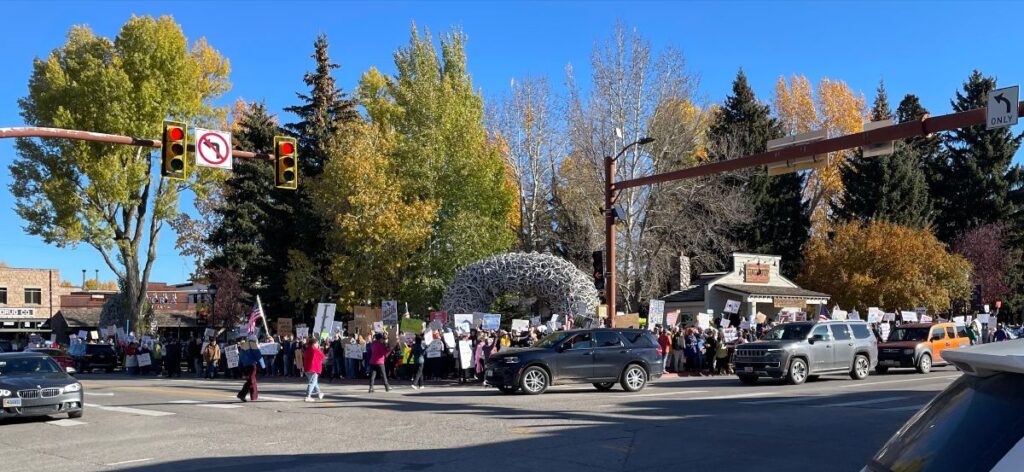
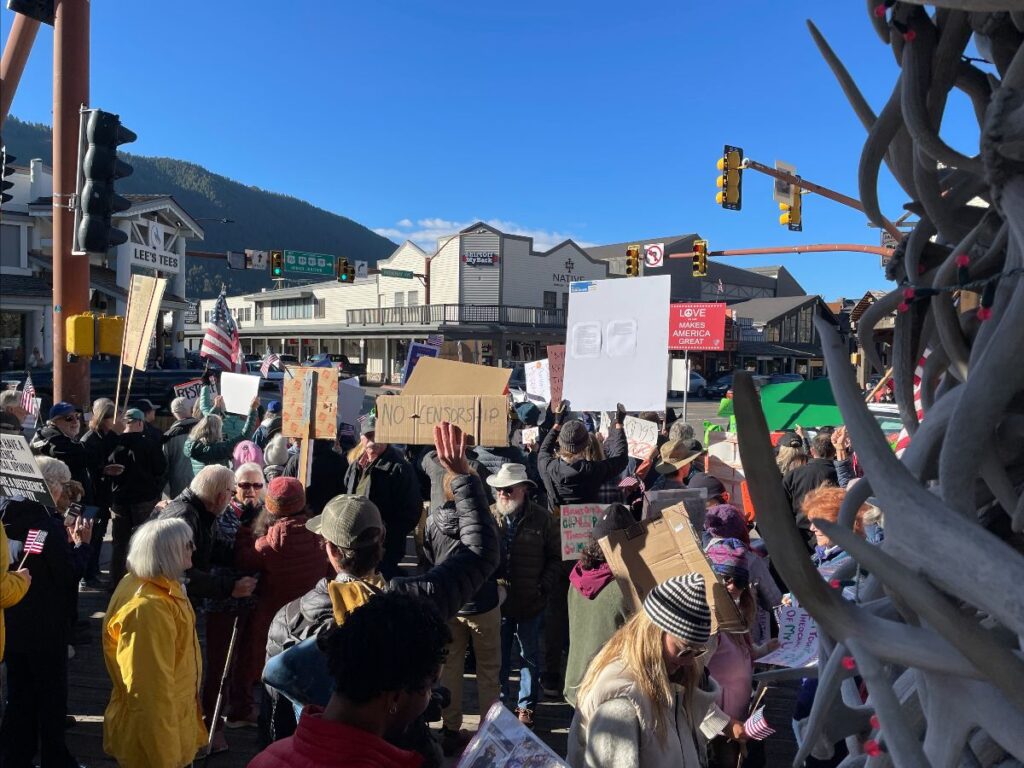
Last week, I attended Jackson’s “No Kings” rally.

To honor my personal brand of being a data wonk, during the rally I counted the crowd a couple of times. Both times I counted at least 750 people. Yet because the mix of folks seemed to change between counts, I’m guessing the total turnout was well north of 750.

I was surprised by the large number of rally-goers. Even more surprising was how festive the event was. While a few leather-lunged types encouraged the crowd to shout rabble-rousing chants, for the most part they were ignored. Instead, the mood was celebratory.

Part of the mood was due to the fact it was a glorious autumn day. Mostly, though, I think the festive mood occurred because, in coming together, hundreds of people anxious about America’s future realized they had kindred souls: “I may be crazy, but I’m not alone in being crazy!”

After the rally, I read accounts about other No Kings rallies across the country. They suggested that most of America’s 2,600 other rallies were similar to Jackson’s: lots of people, joyful, and without incident.

Some stories, though, featured quotes from Wyoming Senator John Barrasso, and they sent me into a funk. Specifically, in the run-up to No Kings, Sen. Barrasso demonized and delegitimized everything about the event, and everyone involved with it. In the senator’s construction, the gatherings were “I Hate America Rallies,” the organizers were “radical leftists,” and the attendees were members of “far-left activist groups.”

In my experience, none of this was true. In fact, just the opposite.

What really depressed me, though, was that such fact-free, ad hominem attacks are very non-Wyoming.

Thanks to our small population, Wyoming’s elected officials and their constituents know each other very well. Yet there was our senior US senator, vilifying constituents he knew to be anything but America-hating far-left radicals.

Rather than simply stew about the issue, I sent Sen. Barrasso the letter that forms today’s CoThrive. As is the case with any personal writing, what I wrote is obviously as much about me as it is about the senator. Reflecting on it, basically what I asked of Sen. Barrasso was to be the kind of elected official I aspire to be.

With luck, I hit that mark more often than not. With luck, so will he.

As always, thank you for your interest and support.

Jonathan Schechter
Executive Director

PS – In my September 24, 2025 CoThrive, I posed five questions which I feel frame Jackson Hole’s future. As part of the Teton County Library’s “Swap Meet” series, I’ll be leading a discussion about the questions at the library on Thursday, November 13, from 7:00 – 8:30 pm. If you’re interested in joining the conversation, I’d love to see you there.

The questions are:

  • Our ecosystem: Is it still our priority?
  • Our character: What do we value?
  • Champagne tastes; beer budget: What is the proper role of government?
  • Subsidizing local business: Whom shall we house?
  • Gridlock: How much traffic are we willing to put up with?
No Kings I

Letter to US Senator John Barrasso

Dear Senator Barrasso,

At the end of last week, you gave a speech on the Senate floor calling October 17’s “No Kings” rally the “I Hate America” rally. You also claimed that the organizers were “radicals” and “far-left activists.”

As I read them, your remarks implied that all No Kings attendees were certainly America-haters, and most likely far-left radicals to boot. I disagree. As evidence, I’d like to offer a profile of myself – someone who, along with 750+ of your other constituents, attended Jackson’s No Kings rally.

I moved to Wyoming in the mid-1980s, about the same time you did. During my time in Jackson, I’ve hated America so much that I’ve raised my son here, coached youth soccer, and done scads of additional volunteer work for local schools, non-profits, and other organizations. All with the hope of leaving my community a little better than I found it.

My hatred of America has also extended to starting and running several small businesses and non-profits, and serving on the boards of others. In fact, I hate America so much that I served eight years as an elected trustee of St. John’s Health, another volunteer job.

For some people, this might have been enough. But feeling the need to express my radical far-left hatred of America even more, I am now in my seventh year serving on Jackson’s town council.

“Aha,” you might say. “All elected officials in Jackson are far-left activists.” While that may be the view from Washington, I ask you to consider that, over the last several years, I have been firm in not wanting to raise taxes, and firm in insisting that the town take a hard look at its expenses.

Which, I’m guessing, is a perspective similar to the one you bring to your job as an elected official.

For as far-left and America-hating as all this is, though, perhaps the apex of my radical America-hating, far-left activism is this: I’ve repeatedly voted for you.

I’ve voted for you because you struck me as a sensible person, someone grounded in core American and Wyoming values such as common sense, neighborliness and temperance in thought, word, and deed. I believed you were someone whose Wyoming sensibilities gave you the ability to rise above the kind of vitriol and lunacy that’s wracking our nation. That’s wrecking our nation.

I believed you were someone who wouldn’t succumb to Washington’s swampiness and craziness and pettiness, but would instead infuse the Senate with our state’s well-deserved reputation for accepting people for who they are, and treating even those with whom we disagree with warmth and respect.

Yet there you were on the Senate floor, attacking folks like me. Suggesting that I and the other 750+ people who attended Jackson’s No Kings rally are America haters and radical left-wingers.

Again, I disagree.

Had you been at Jackson’s No Kings event, you would have been among 750+ constituents who, contrary to your assertions, love their nation and worship its ideals. People who have served their community, state, and nation not because they hate them, but because they love them. Just like you.

These 750+ folks are heartbroken over how America’s core values – honesty, integrity, the rule of law, and so many more – are getting trampled by the Trump administration. And disturbed even further by how this trampling is being abetted by the legislative branch, some of whose members seem more interested in vilifying their constituents than providing the checks and balances mandated by the Constitution.

I don’t hate America, sir. Instead, I feel this quote from Mark Twain describes me pretty well: “Patriotism is supporting your country all the time, and your government when it deserves it.”

At the moment, I think it’s an open question whether the government deserves our support. What’s not an open question, though, is whether people who attended Jackson’s No Kings rally hate their country. The answer is a resounding “NO!”

All of us were there because our love of country compelled us to be. We raised our voices not out of hatred, but out of an abiding love for an America we feel is losing its Constitutional moorings.

Using Twain’s construction, Jackson’s No Kings demonstration was a gathering of patriots. Using your construction, rather than an “I Hate America” rally, what occurred on October 18 was an “I Love America” rally – 750+ of your constituents exhibiting patriotism at its finest, born of a deep, deep love of the United States.

In closing, let me offer this. Before you entered politics, you entered medicine. When you did, you took the Hippocratic Oath to heal the ill and infirm, and at worst do no harm.

Right now, America is, at best, infirm. One of the causes of our illness is the growing tendency not to discuss and debate, but to demonize and delegitimize.

To heal, our nation needs its leaders to bring us together.

You can be one of those leaders, Dr. Barrasso. You’re in a position to demonstrate not just to your constituents but to the entire nation what it means to embody core Wyoming values such as mutual respect and an awareness we’re all in this together.

Sadly, your recent comments moved us away from where we need to go. Please do better. I know you can.

No Kings: II
No Kings: III

Filed Under: Uncategorized

Two Quotes; Five Questions; One Future

September 24, 2025 By //  by cothrivejs

Hello, and happy Autumnal Equinox!

Growing up in Southern California, it was always a treat when our parents took us to Baskin-Robbins 31 Flavors for ice cream.

Well, mostly it was a treat.

The problem for me was that, without fail, I’d be overwhelmed by the number of choices. I’d ask for a taste of this and a taste of that and, the next thing I knew, my father was barking at me to make up my mind because everyone else was ready to go.

At that point, drowning in indecision, I’d invariably freeze up and fall back on one of my two security flavors: vanilla or, if I were feeling daring, Pralines & Cream.

Completely lame, but that was my reality. Arguably, aspects remain.

I mention this because I ended my most recent CoThrive by saying I’d focus this edition on steps Jackson Hole might take to address the region’s extraordinary growth and change. Since publishing that piece, though, there’s been so much craziness at the federal level that, a’la Baskin-Robbins, I’m feeling overwhelmed by things to write about.

My rule of thumb for CoThrive is to stick to my knitting; i.e., focus on things related to the greater Tetons region and similar, desirable places to live. Today, however, I offer a two-fer.

Tying together the two pieces is my belief that, in order to successfully address a situation, you must first understand it. To that end, each part of today’s newsletter reflects efforts I’m making to better understand the forces upending the region, nation, and world.

Part 1 is a couple of quotes I found useful in helping me understand the craziness of our times. Not what is happening, nor how to solve it. But why it’s happening – no small deal.

Part 2 is the follow-up I promised, namely five questions I feel Jackson Hole must answer if we are to have any chance of controlling our future. These are an extension of my belief that:
in order to successfully address an issue, you must first deeply understand it; and
in order to deeply understand an issue, you must first ask the right questions.
As I say, a two-fer.

Thank you for indulging my indecisiveness, and a special thanks for not barking at me.

Jonathan Schechter
Executive Director

Autumn arrives: I

Part 1: Two Quotes

Quote 1

In her 2023 book Doppelganger, Naomi Klein made the following observation. It’s helped me understand why our world seems so utterly chaotic.

“A state of shock is what happens to us, individually or as a society, when we experience an unprecedented event for which we do not yet have an adequate explanation.

“At its essence, a shock is the gap that opens up between events and existing narratives to explain that event.

“Being creatures of narrative, humans tend to be very uncomfortable with meaning-vacuums. Which is why those opportunistic players – the people I’ve termed “disaster capitalists” – have been able to rush into the gap with their preexisting wish lists and simplistic stories of good and evil.

“The stories themselves may be cartoonishly wrong – “you’re either with us or with the terrorists” they told us after September 11; along with “they hate our freedoms” – but at least those stories exist. And that alone is enough to make them better than the nothingness of the gap.

“‘Gather together, find your footing and your story.’ That is the advice I’ve been giving for two decades for how to stay out of shock during moments of collective trauma. ‘Metabolize the shock together’ I would tell people. ‘Create meaning together. Resist the tinpot tyrants who will tell you that the world is now a blank sheet for them to write their violent stories upon.’

“It was solid advice, but COVID made it so very hard to act on. Controlling the virus forced onto many of us, including me, the very conditions that make humans most vulnerable to states of shock: prolonged stress and isolation.”

Unfortunately, we live in times hallmarked by prolonged stress and increasing isolation. Our challenge? To create a narrative to explain what’s going on. From there we can develop some solutions.

Quote 2

In the wake of Charlie Kirk’s killing, the federal government forcefully threatened Americans’ sacrosanct freedom of speech. Shocked, I did a quick Google search and found the following – a ringing affirmation of how critical the First Amendment is to our nation. I’ve lightly edited it to help its majesty shine through.

“I. The First Amendment to the United States Constitution, an amendment essential to the success of our Republic, enshrines the right of the American people to speak freely in the public square without Government interference. (It is intolerable for the Federal Government to trample)… free speech rights by censoring Americans’ speech… exerting substantial coercive pressure … moderate, deplatform, or otherwise suppress speech that the Federal Government did not approve. Under the guise of combatting ‘misinformation,’ ‘disinformation,’ and ‘malinformation,’ the Federal Government (cannot infringe) on the constitutionally protected speech rights of American citizens across the United States in a manner that advance(s) the Government’s preferred narrative about significant matters of public debate. Government censorship of speech is intolerable in a free society.

“II. It is the policy of the United States to:
(a) secure the right of the American people to engage in constitutionally protected speech;
(b) ensure that no Federal Government officer, employee, or agent engages in or facilitates any conduct that would unconstitutionally abridge the free speech of any American citizen;
(c) ensure that no taxpayer resources are used to engage in or facilitate any conduct that would unconstitutionally abridge the free speech of any American citizen; and
(d) identify and take appropriate action to correct past misconduct by the Federal Government related to censorship of protected speech.”

Powerful. Unambiguous. An affirmation of the best of us as a people and country.

There’s a punchline, though. The above is excerpted from Executive Order #14149. Entitled “Restoring Freedom of Speech and Ending Federal Censorship,” it was signed by President Trump on January 20, 2025.

The huge and growing gap between the clarity of this order and the Trump administration’s recent threats to freedom of speech have added to my shock.

In particular, falling into that gap are the values underpinning the narratives I was raised with, including the importance of telling the truth, sticking to your word, treating others with respect, and honoring our system and its laws.

Worse still is that some elected officials who took an oath to “support and defend the Constitution of the United States” are staying silent regarding this attack on the Constitution. And while the elected office I hold is pretty darned inconsequential, I, too, took an oath to defend the Constitution. Which means supporting what Executive Order #14149 says about the inviolate importance of free speech.

(Note: The edits I made removed the order’s references to social media and the Biden Administration. I made them to offer you an unbiased take on the order. To read the entire order, click here)

Autumn arrives: II

Part 2: Five Questions

Here’s my theory.

Like most communities, Jackson Hole has a distinct character – a set of values, mores, behaviors, and attitudes that shape who we are. These qualities aren’t formalized or written down. Nor are they passed on in any formal way. Instead, over time new arrivals learn them through an informal process of social osmosis.

At least that’s how things have worked. My concern is that those days are over.

Instead, over the last few years the forces of growth and change have become so powerful that they’re overwhelming our informal osmotic process. As a result, the qualities that have long-distinguished the community are being steamrollered, leaving us with little besides the residue of that flattening: homogenization, and an emphasis on financial success.

Given this, I believe we need to develop ways to formalize who we are, what we stand for, and how to pass these characteristics from one generation to the next. I’m not happy about the prospect of formalizing the once-informal, but I see no other choice. Without some sort of formal cultural transmission process, I don’t see how Jackson Hole will be able to withstand the forces working to make us feel like every other mountain town (and they like us).

The first step in this process is to answer five questions that, collectively, shape Jackson Hole’s distinct character. The clearer we can be in our answers, the better our chances of controlling our own destiny.

Question 1.
Our ecosystem: Is it still our priority?

The Vision Statement of the Jackson/Teton County Comp Plan is twenty-one words long.

Its first six words are its essence: “Preserve and protect the area’s ecosystem…” Its final fifteen words are its rationale: “…in order to ensure a healthy environment, community, and economy for current and future generations.”

In other words, if we preserve and protect our ecosystem, all sorts of good things will happen. If we don’t, they won’t.

We are able to have our vision because we have an intact ecosystem to preserve and protect. Which is a remarkable thing: In the 250+ years since the dawn of the Industrial Revolution, the greater Jackson Hole/Yellowstone region is the only place on Earth that has developed a successful industrial or post-industrial economy AND maintained a healthy, fully-functioning ecosystem. Yet today, that ecosystem health – that essence of our vision – is under threat from forces ranging from global warming to the region’s increasing attractiveness to visitors and prospective residents.

Rarely do humans set out to destroy an ecosystem. Instead, the damage occurs slowly, as one compromise after another is made in the name of balance, growth, or what have you.

Regardless of the rationale, though, the end result is the same. Like the proverbial frog in the slowly-heating pot of water, the 250 Year Precedent tells us that, eventually, enough compromises will be made to any ecosystem that its health will be sacrificed. Not its beauty – how many beautiful places can you name? But take that question a step further and ask yourself: “How many of those beautiful places have fully-functioning ecosystems AND a robust contemporary economy?” Alas, outside of the Greater Yellowstone, I fear the answer is “none.”

Given this, are we willing to take the steps needed to keep our ecosystem intact? Or will we succumb to the 250 Year Precedent and make choices that, for whatever reason, end up compromising the ecosystem’s health?

Question 2.
Our character: What do we value?

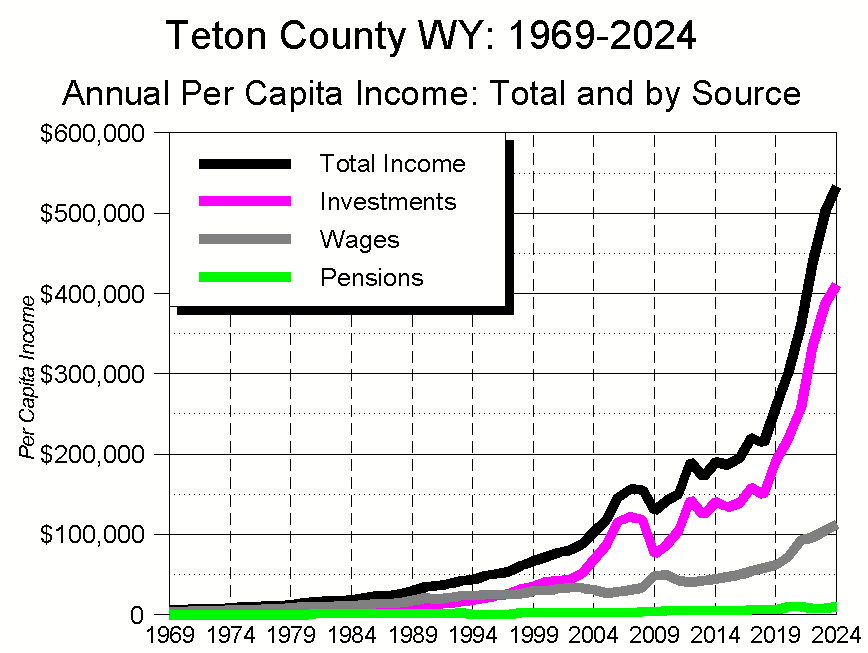
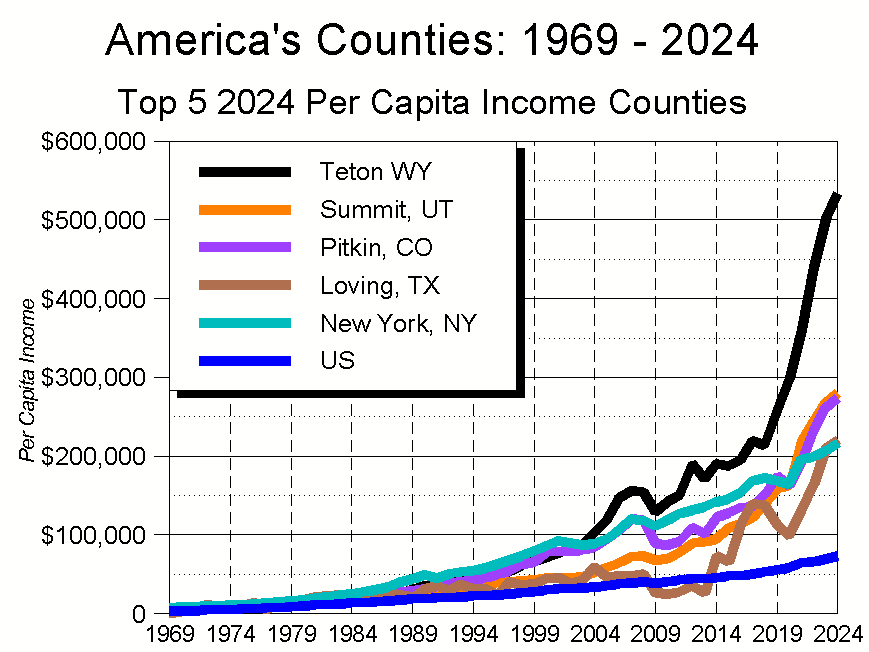
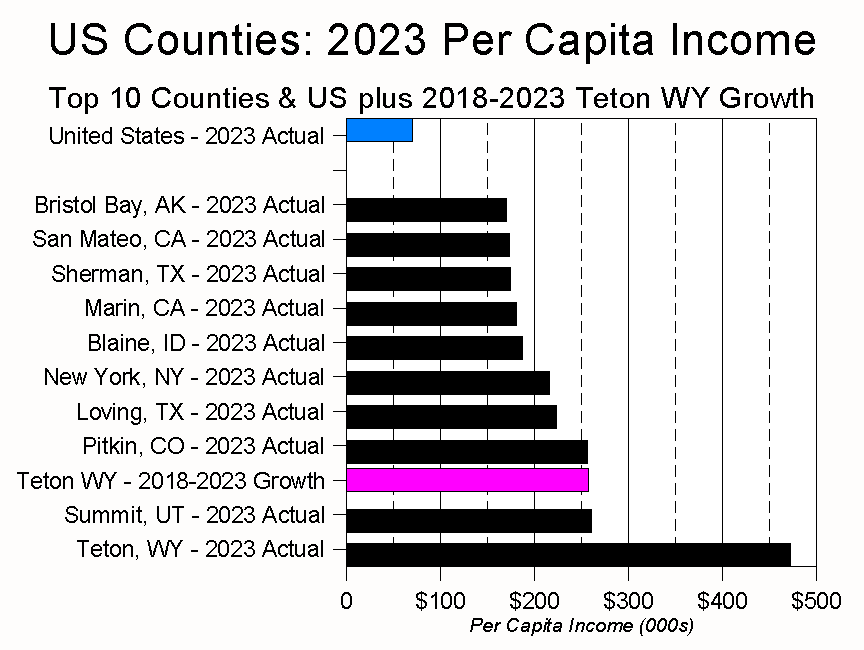
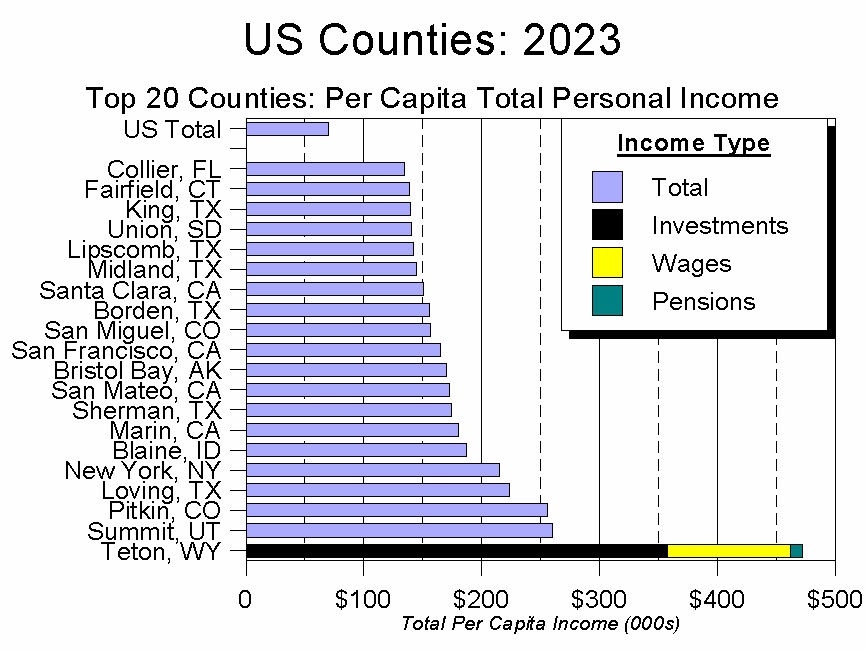
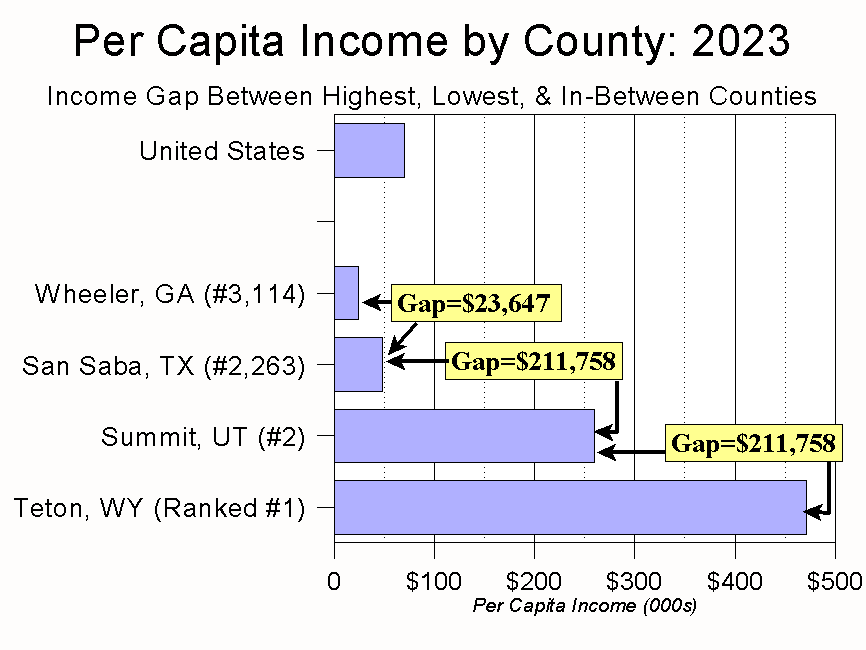
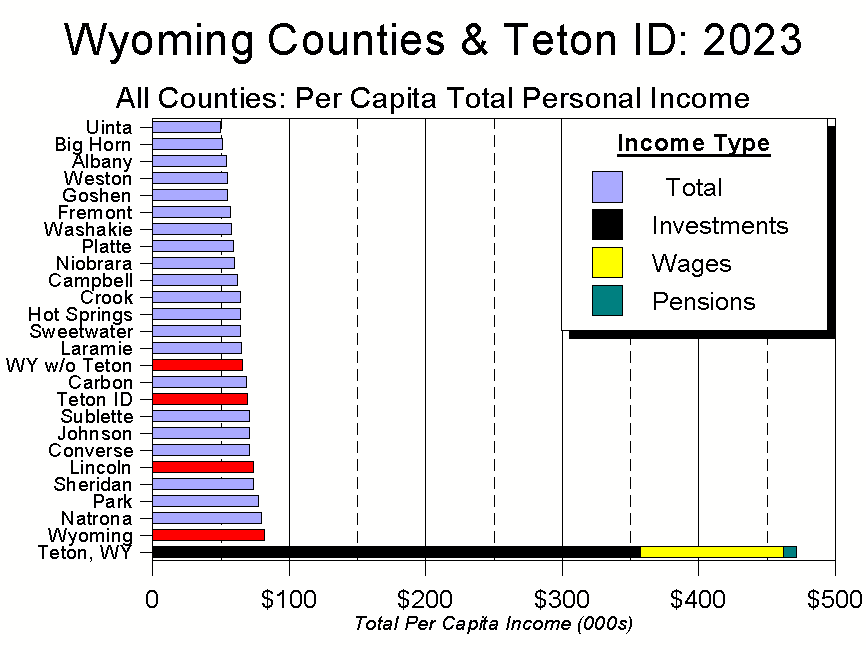
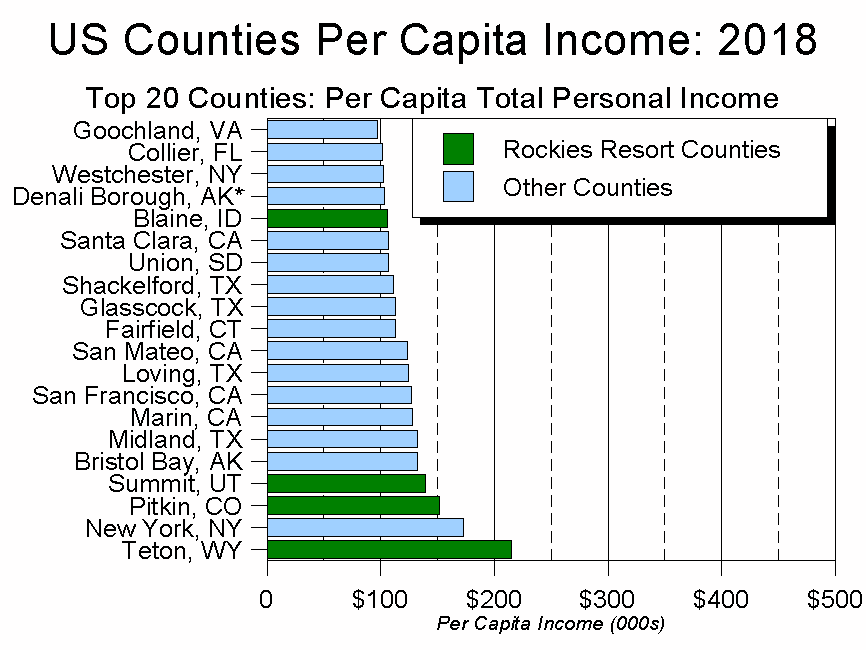
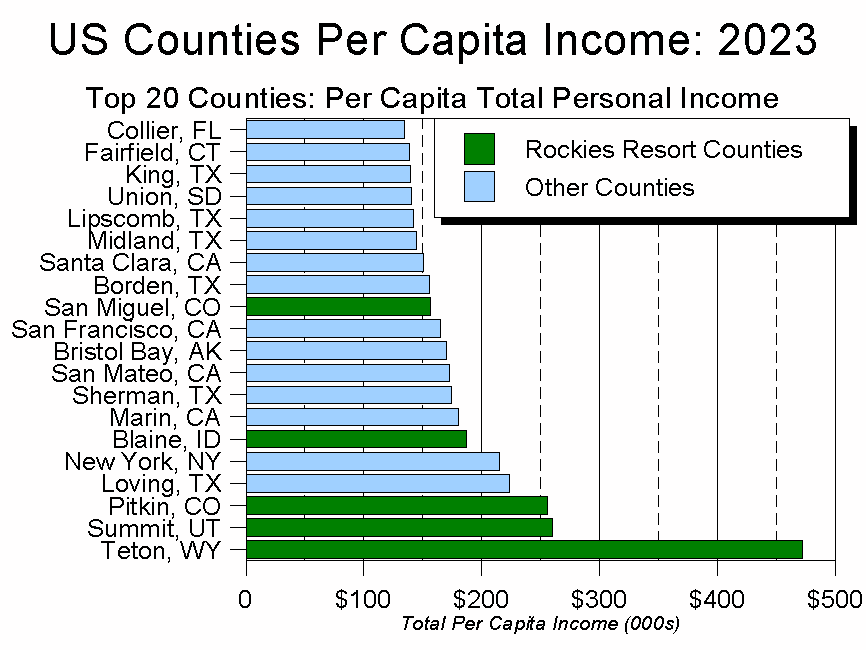
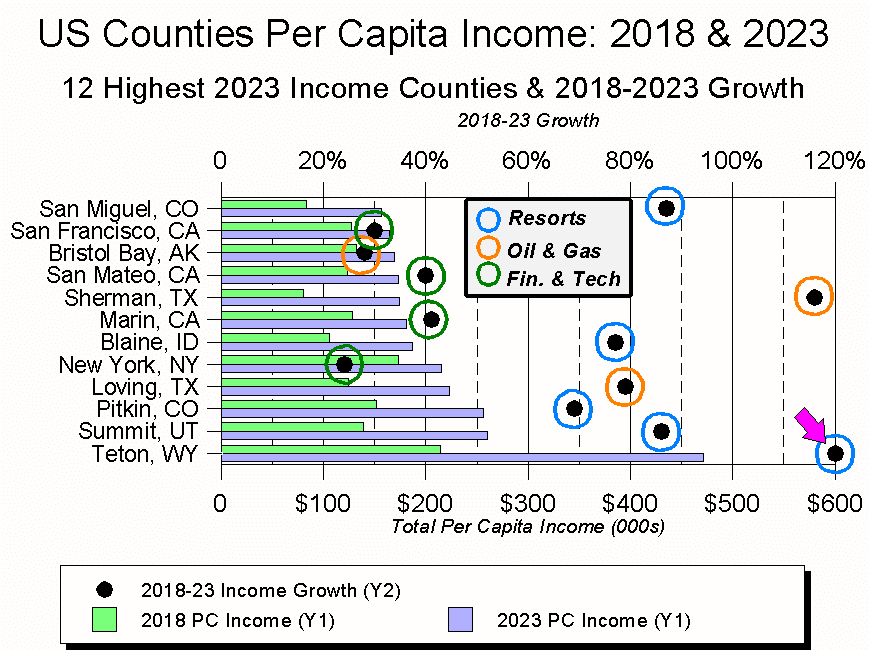
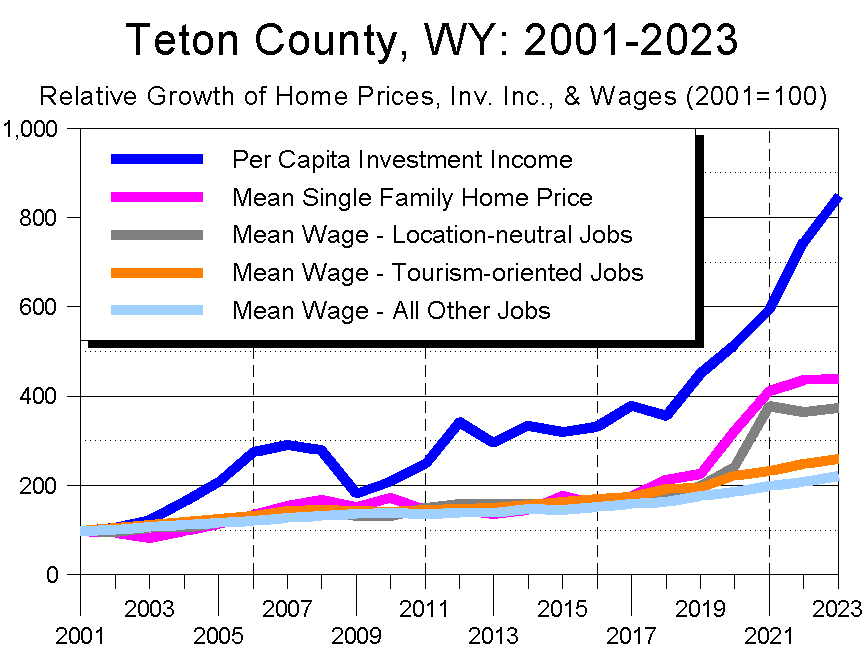
In 2018, Teton County’s nation-leading per capita income was $214,681. In 2023, our nation-leading per capita income was $471,751. This means that in five years, Teton County’s per capita income grew $257,070. Which, in turn, is a greater amount than the 2023 per capita income of all but one other US county. (Figure 1)

Such extraordinary growth is indicative of the dramatic change that has swept over Jackson Hole over the past 5-10 years. How to address such powerful forces? The place to start is by clearly identifying our values and priorities.

Question 1 asks us to affirm whether ecosystem health remains our paramount priority. Question 2 asks what else we value. Unfortunately, it’s been over a decade since Jackson Hole has had such discussions; i.e., we’ve not spoken about what matters to us since the current trends buffeting us really kicked into gear.

Such conversations are difficult. The longer we postpone them, though, the likelier it is that we’ll lose control over our destiny.

Figure 1

Question 3.
Champagne tastes; beer budget: What is the proper role of government?

Jackson Hole is a 21st century community with a 20th century operating system. Perhaps the clearest example of this is the large and growing disconnect between the local economy and how local government generates revenue.

For instance, since 2020, Teton County has sold essentially the same amount of taxable goods as it has real estate: $10.8 billion and $10.6 billion respectively. Yet we don’t tax real estate sales. Nor do we tax residents’ income which, in 2023 alone, totaled $11.0 billion.

Because of this 21st century/20th century disconnect, local government’s expenses are going up faster than its revenues. As a result, no matter how much government tightens its belt (which is the necessary next step), residents will soon need to choose one of two options:

  1. Keep the current tax structure
    • Do this, and it means accepting fewer and/or lower-quality government services
  2. Keep the same level of local government services (or perhaps expand them)
    • Do this, and it means paying higher taxes

To make this choice, we need to decide what role we want local government to play, what services we want it to provide, and the like. As with Questions 1 and 2, this question, too, requires a deep community-wide discussion.

Question 4.
Subsidizing local business: Whom shall we house?

As is the case with most other desirable places to live, Jackson Hole has affordable housing programs. Why? Because for developers, high-end homes are profitable and workforce housing is not.

Rarely mentioned in affordable housing discussions, though, is another reality: When the community provides affordable housing, we’re subsidizing the industries that can’t or won’t pay their employees enough to afford local housing.

This suggests the need for another conversation. Because we’ll never be able to build enough affordable housing for everyone who wants it, who should get the housing we do build? Should it be open to all comers? Should we prioritize essential service providers or some other cohort? Should government even be in the affordable housing game at all?

Which in turn leads into two larger conversations. One is practical: Given Jackson Hole’s resources – financial, human, legal, and other – what affordable housing efforts should we be making, and what expectations should we have for those efforts?

The other is existential: Looking out 10, 25, 50 years and more, what kind of community do we want to be? The affordable homes we build today will answer that question by determining who can live here in the future. Before we build those units, we need to be clear about not just who we want living in them, but why.

Question 5.
Gridlock: How much traffic are we willing to put up with?

Over the past decade, the traffic counts on Jackson Hole’s different roads have increased between 20%-55%. With the exception of the landslide-affected Highway 22/Teton Pass, 2024 was the busiest year in history for all of Jackson Hole’s major roads.

A daisy chain of causes underlies this growth.

It starts with Jackson Hole being both a tax haven and a very attractive place to live. Combined, these qualities have attracted a slew of new, wealthy residents and produced a booming economy. Which, in turn, has led to a job boom. Which, in turn, requires ever more workers.

Between the job boom and the newer, wealthier residents, demand for housing has risen, driving up prices. As that’s occurred, workers relying on local wages have been priced out of the Jackson Hole valley, leading them to move to Idaho or Star Valley. As that’s happened, they’ve become commuters. As that’s happened, traffic has soared.

This dynamic has led some people to advocate for building a lot more workforce housing in Jackson Hole. The logic of this argument is that if we build more homes, fewer people will need to commute. The only way this logic holds, though, is if job growth stops.

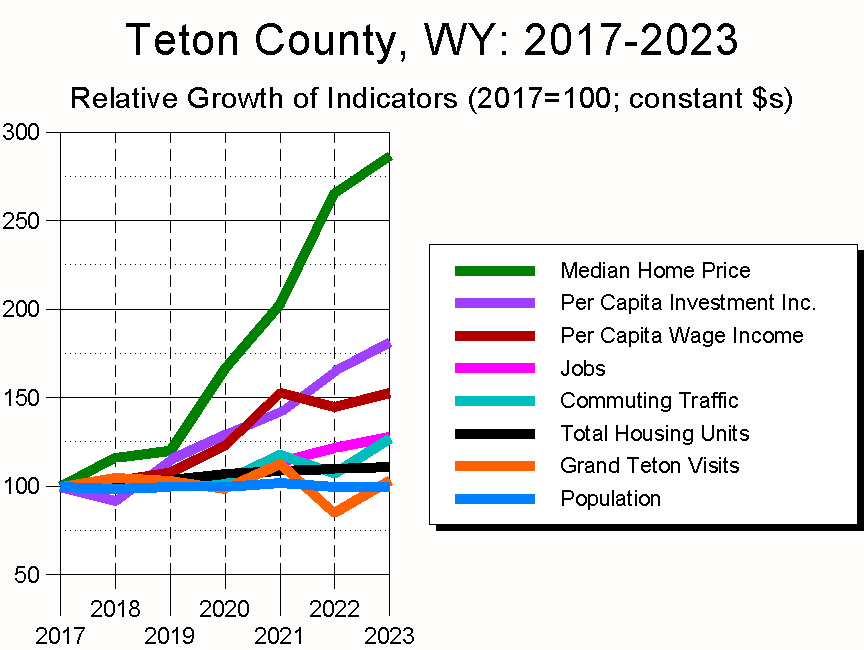
If it doesn’t – if a former commuter is replaced by a new commuter filling a new job – then traffic will get worse. Which is exactly what we’ve been seeing: Over the past several years, jobs and traffic have been growing pretty much in lockstep. (Figure 2)

As long as Jackson Hole continues to create more jobs and attract more visitors, our traffic problems will get worse. Which in turn means we need to ask ourselves yet another hard question: How much traffic are we willing to bear?

Figure 2

Comment

Recently, Jackson’s town council discussed what we do and how we do it.

During the conversation, I offered my belief that the council has just three roles:

  1. Do whatever is legally required of us by the state;
  2. Make policy; and
  3. Act as fiduciaries for the organization and community.

To me, acting as a fiduciary has two elements: financial and temporal. “Financial” means ensuring that the public’s money is spent wisely and well. “Temporal” means always being aware that the decisions we electeds make will affect Jackson for decades, if not centuries to come.

Arguably, this temporal perspective was easier to embrace when Jackson Hole’s geographic isolation limited the pace of growth and change – when a place is hard to get to, things don’t move too fast.

In the last generation, though, as technology has rendered geographic isolation increasingly moot, we’ve changed dramatically. No longer can a median income buy a median priced home. No longer do we aspire to reach 200,000 commercial airline enplanements (we’re now north of 550,000). No longer is being a UPS driver one of the few jobs in Jackson Hole that offers year-round employment and good benefits.

The list goes on, but the examples all point to the same conclusion: As we have become increasingly connected to the outside world, Jackson Hole has dramatically changed.

One thing that hasn’t changed is our inherent warmth and hospitality: We still embrace newcomers. Our mechanisms for teaching newcomers what it means to be a Jackson Holer, though, are increasingly unable to keep up with the socio-economic forces washing over us. Sadly, these forces are indifferent to the community’s people, character, and essence. And that leaves us increasingly vulnerable.

Rigorously asking and answering the five questions I pose above can provide a bulwark against the unrelenting forces of growth and change. What do you think? What are your answers? I’d love to know.

Autumn arrives: III

Filed Under: Uncategorized

Ski Bum Gentrification

September 17, 2025 By //  by cothrivejs

Hello, and happy September!

Every summer, the Philadelphia-based Global Interdependence Center holds a conference in Jackson Hole. Two years ago, I was asked to address it. I happily agreed to do so. Unhappily, I thought I bombed.

So much for my ability to read a room. Instead of bombing, the GIC folks liked my talk so much that they invited me to speak again this summer, which I did in July.

One of the attendees was Michael McKee, the International Economics and Policy Correspondent for Bloomberg TV and Radio. A month later, Mr. McKee interviewed me for a 12-minute Wall Street Week story about Jackson Hole. It ran in late August, and you can watch it by following THIS LINK.

I mention this for two reasons.

First, the piece does a nice job capturing the basic issues facing Jackson Hole, as well as the dynamics shaping how the community might approach them.

Second, I need your help.

Each year, the Community Foundation of Jackson Hole stages Old Bill’s Fun Run, a remarkable fundraising event for local non-profits. During the weeks around Old Bill’s, local non-profits solicit donations. Every dollar raised up to $30,000 is matched at a level which has historically ranged from 50%-70%.

My Charture Institute participates in Old Bill’s, and the money we raise is vital to our operations. Specifically, it helps fund research pieces such as this newsletter, which in turn leads to the broader understanding of Jackson Hole I shared with the Wall Street Week audience.

Switching back to the present, the focus of today’s CoThrive is an idea I’ve recently hit upon and been noodling over: Ski Bum Gentrification. I hope you find it of interest.
Gentrification
Other Areas; Same Phenomenon
Discussion
The Immodestly-Named
When History (or Culture) Starts

As always, thank you for your interest and support.

Jonathan Schechter
Executive Director

PS: At an event a few days ago, I was seated next to another long-time journalist. He shared two thoughts with me: “I like your newsletters” and “Length is the enemy of readership.” In other words, he was advising me to shorten my newsletters.

I promised I’d try and, in pursuit of shorter newsletters, I’ve broken today’s offering in two. Below I describe what I’ve come to call “Ski Bum Gentrification.” In my next CoThrive I’ll offer “Next Steps.”

Old Bill’s Fun Run 2025

Gentrification

Besides being the apple of my eye, my son is also an assistant professor of sculpture at Clemson University.

Alex did his graduate work in Baltimore, where both his art school and residence were in an older, run-down part of the city. When visiting him once, he pointed out that for all of Baltimore’s many efforts at urban renewal, none had worked as well as a more organic process: artists revitalizing an area by moving into places most people viewed as decrepit.

Lacking income but overflowing in vision, Baltimore’s starving artists saw the buildings around the school not as abandoned warehouses and old row houses, but inexpensive studios and living spaces. Acting on this vision, a hearty few moved into those buildings. Then a few more did, followed by a few more. Eventually, this set the stage for commerce: a bodega here; a coffee shop there. Thus began a positive feedback loop: Growing numbers of residents and businesses made it increasingly easy for others to move in, particularly those with a lower tolerance for risk and discomfort.

The result? Gentrification.

Arguably, something similar has happened to Jackson Hole over the past 60 years or so.

While Jackson Hole has never been blighted or unsafe, until the mid-1960s the valley’s socio-economics were defined by its remoteness and hardscrabble economy. In fact, the economy was so challenged that a key chunk of the Jackson Hole Ski Area’s initial funding came from a federal economic development grant program designed for Appalachia and other deeply impoverished areas.

For most folks, that kind of hardship is a deal-breaker. For a handful of ski bums, dirt bags, and other outdoor enthusiasts, though, the appeal of living in an extraordinary ecosystem and fabulous outdoor playground trumped the area’s challenges. Like their urban starving artist brethren, these mountain town starving ski bums saw unrealized potential. And in the same way starving artists have helped revive gritty urban neighborhoods, starving ski bums began a process that ultimately resulted in the gentrification of Jackson Hole.

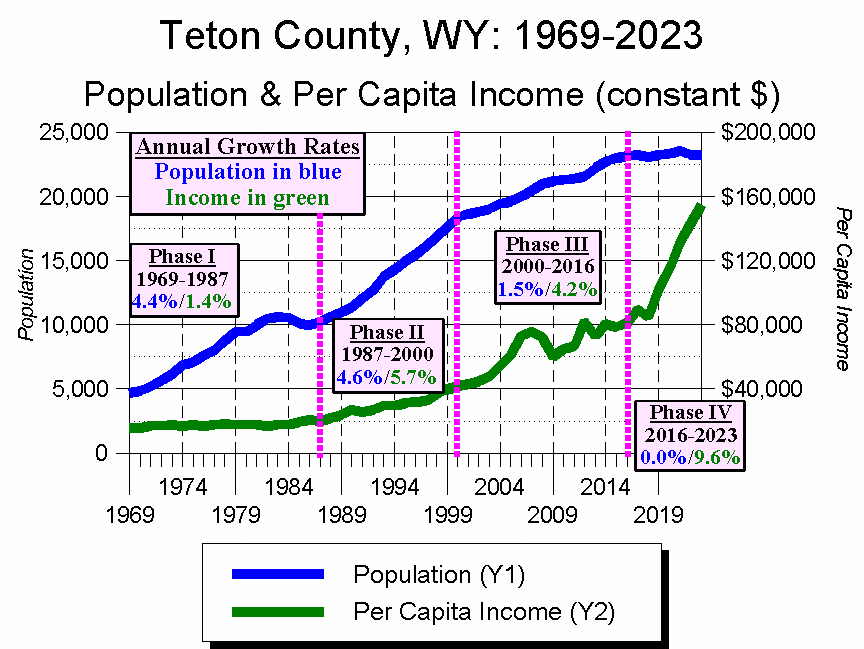
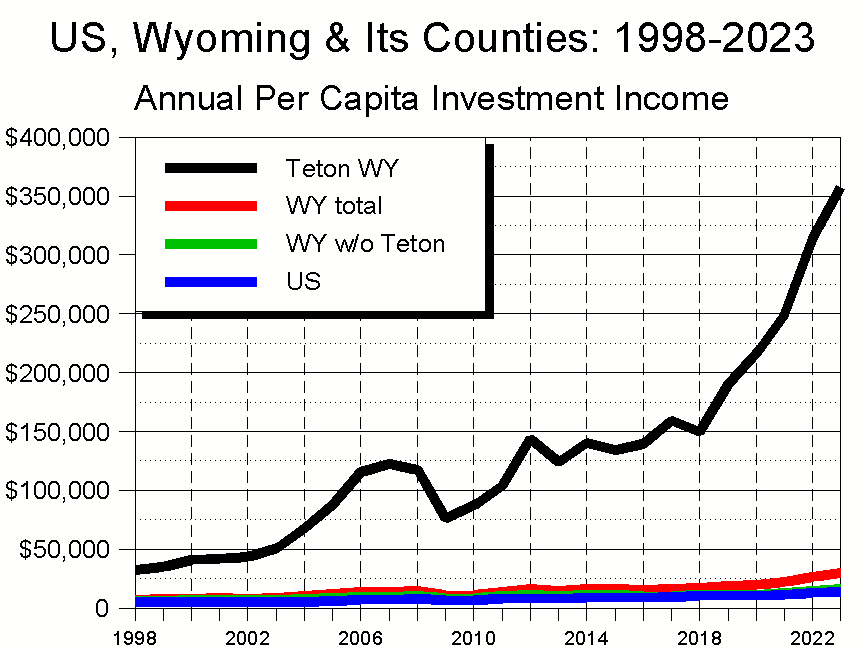
Figure 1 gets at how this “Ski Bum Gentrification” process has evolved over time.

Figure 1

Good socio-economic data about every US county are available from 1969 through 2023. Happily, this spans nearly the entire time the Jackson Hole Mountain Resor has been open (its first full winter was 1965-66).

During the ski area’s first two decades, Teton County, Wyoming’s population grew far more rapidly than its income. Specifically, between 1969-1987 Teton County’s population grew at a Compounded Annual Growth Rate (CAGR) of 4.4%, while its inflation-adjusted per capita income grew one-third as fast: 1.4%.

Let’s call this period – hallmarked by rapid population growth and little economic growth – “Ski Bum Gentrification Phase I.” Those who moved to Jackson Hole during that period may have had to scramble to make a living, but over time a fair number of these folks made it work. As a result, 20 years later the community’s demographics had markedly changed: When the ski area opened in 1965, there were around 3,500 people living in Teton County; in 1985 there were three times as many.

Phase I of Jackson Hole’s Ski Bum Gentrification ended in the late 1980s, when the community finally pulled out of the recession that had plagued America earlier in the decade (Jackson Hole’s economy usually lags behind the nation’s). This marked the beginning of Ski Bum Gentrification Phase II, which is hallmarked by equilibrium: In Teton County, population growth remained robust and income growth skyrocketed to similar levels.

The fact income shot up suggests that the influx of ski bums had created a demographic critical mass – all of a sudden, there were enough people to support a new, more vital economy. For Jackson Hole, Phase II ran from the late 1980s until the turn of the century.

Phase III of Ski Bum Gentrification is when gentrification starts to become noticeable. During this phase, population growth drops sharply, income growth stays high, and the cultural changes wrought by the earlier phases’ population boom start to affect everything from architecture to the mix of businesses. Critically, as gentrification starts to become apparent, it becomes increasingly comfortable-cum-acceptable for people of means to move to a place, thus accelerating the gentrification process. Locally, Phase III ran from around 2000 to 2016 or so.

Jackson Hole is currently in Phase IV of Ski Bum Gentrification. This is gentrification’s climax state: Income growth booms and the population stops growing.

Just because Jackson Hole’s population isn’t growing, however, doesn’t mean it’s stagnant. Instead, it’s churning: Similar numbers of people are moving in and out, but the people moving in are earning far more money than the people moving out.

The people moving in are also earning more than people already living here. As Figure 2 shows, during Phase III, the annual income of current residents (i.e., “non-migrants”) was, on average, 30% higher than that of those moving in; during Phase IV, the annual income of new arrivals (i.e., “in-migrants”) has, on average, been 9% higher than that of current residents. Which makes one wonder whether there isn’t a kernel of truth in the joke about Jackson Hole’s billionaires pricing out its millionaires.

Figure 2

Other Areas; Same Phenomenon

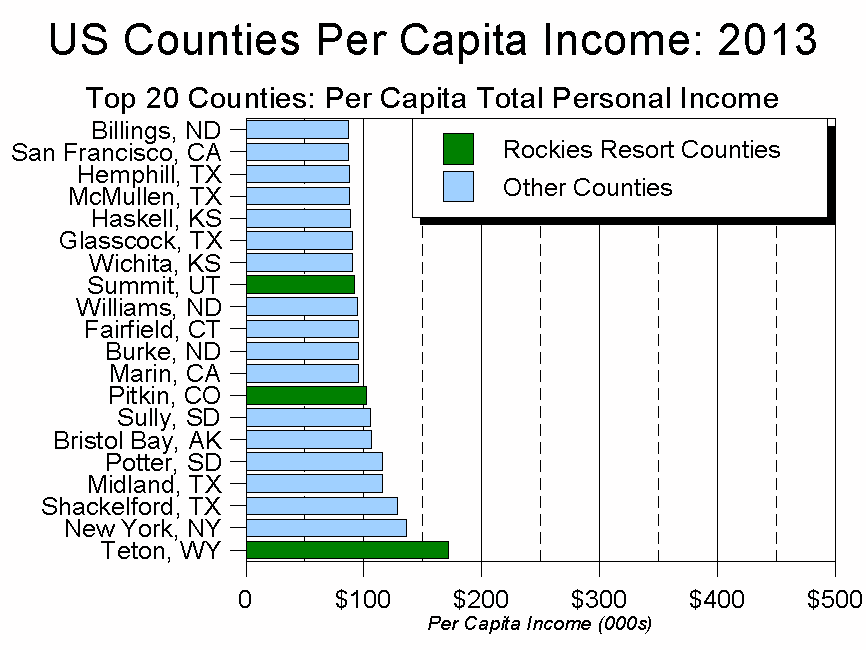
Nationwide, there are 3,140 counties. In 2023, five Rocky Mountain ski counties ranked in the nation’s Top 12 in per capita income:

  • Teton, WY (Jackson Hole ranked #1)
  • Summit UT (Park City, #2)
  • Pitkin CO (Aspen, #3)
  • Blaine ID (Sun Valley, #6)
  • San Miguel CO (Telluride, #12)

Like Teton County, each of these has undergone a similar process of gentrification. Interestingly, in these five Rocky Mountain ski counties, Phase IV of Ski Bum Gentrification kicked in before the COVID pandemic – rather than fundamentally change things, the pandemic poured gasoline on an already-burning gentrification fire (Figure 3)

Figure 3

Ski Bum Gentrification is not confined to counties with major ski areas. For example, while Teton County, Idaho, isn’t as gentrified as Jackson Hole, it’s going through the same process.

As Figure 4 indicates, until around 1990 Idaho’s Teton Valley was actually pre-gentrified – call it Ski Bum Gentrification Phase 0. During this time, both Teton Valley’s population and income were growing slowly, if at all. Thanks to people being priced out of Jackson Hole, though, about the same time Jackson Hole started its Ski Bum Gentrification Phase II, Teton Valley started its Phase I.

Another local socio-economic joke is that when Jackson Hole catches a cold, neighboring counties contract the flu. Giving credence to this witticism, the 2008 recession actually knocked Teton Valley backwards, driving both its population and income growth essentially to zero. That didn’t last too long, though, because Jackson Hole’s continued growth caused Teton County, Idaho to shoot from Phase 0 to Phase III: Since 2013, Teton Valley’s population CAGR has been 2.1%; its income CAGR has been 6.7%.

Figure 4

Discussion

Why does this matter?

The reason is captured in the Wall Street Week piece mentioned in the introduction. Michael McKee closes the story by saying: “But more than ever before, those who live here will have to reconcile the values of capitalism with a culture born of cowboys and unforgiving landscapes. A culture which may be their greatest asset of all.”

The challenges to our culture are why it’s vitally important to understand Jackson Hole’s Ski Bum Gentrification, especially Phase 1. As a tool for understanding that phenomenon, may I offer the immodestly-named “Schechter’s Equation for Life” and the equally immodest “Schechter’s Maxim.”

The Immodestly-Named

Schechter’s Equation for Life is S = R – E: Satisfaction equals Reality minus Expectations. Its point is that, for you to be satisfied with an occurrence, product, or what have you, it needs to exceed your expectations for it. Otherwise, you have negative satisfaction; i.e., you’re dissatisfied.

The basic point? For something to be successful, calibrating expectations is awfully important.

Continuing down the immodesty path, in its abbreviated form Schechter’s Maxim holds that “Economies change faster than Perceptions, and Perceptions change faster than Politics.”

In its complete form, Schechter’s Maxim holds that:

  • Basic Science changes faster than Applied Science (i.e., technology);
  • Applied Science changes faster than Economies;
  • Economies change faster than Perceptions;
  • Perceptions change faster than Politics;
  • Politics changes faster than Legislation;
  • Legislation changes faster than Jurisprudence.
Figure 5

For the purposes of understanding Ski Bum Gentrification, the importance of Schechter’s Maxim is that Jackson Hole’s economy has changed far faster than residents’ perceptions of the community. Residents may not know why the community is evolving or what it all means, but even the least-aware long-time resident knows today’s community is very different from the one they moved to.

For those folks, their understanding of – and by extension, their expectations for – the community were formed long ago, and in most cases haven’t evolved too much. From expectations about community character and culture to feelings about who can and should live here, many of the beliefs shaping Jackson Hole today can be traced back to when the community was lightly populated, the ski area and national parks were far less visited and, critically, local property values were more-or-less aligned with local wages.

Today, Jackson Hole is home to more than twice as many residents as in 1985, the parks and ski areas have three times more visitors, and local housing prices have long-since blown past local wages. Yet infusing the community’s spirit is a series of expectations – a series of beliefs about what the community is and should be – formed long before any of today’s realities came to be.

That these expectations-cum-beliefs are out of sync with Jackson Hole’s current socio-economic realities goes a long way to explaining the angst people are feeling. Their view of Jackson Hole was formed when they arrived, in many cases decades ago. Under extraordinary socio-economic pressure, though, that Jackson Hole is fading away – is being gentrified by the enormous wealth moving in.

Run this reality through Schechter’s Equation for Life, and the result is a lot of negative satisfaction, especially among longer-term residents.

When History (or Culture) Starts

Decades ago, the ski bum pioneers began a process that changed a ranching community to a ski town, upsetting those invested in the ranching culture. Like yeast in grape juice, though, the ski bum culture was so successful that it created an environment exceptionally desirable to others – particularly the well-to-do – and ultimately toxic to them. As a result, the ski bum culture and its attendant values are being eroded by the socio-economic conditions the ski bums helped to create, and in many cases had come to Jackson Hole to escape.

Irony, meet the forces of capitalism. Or as Mr. McKee might have observed: “… those who live here will have to reconcile the values of capitalism with a culture born of cowboys, ski bums, dirt bags, and unforgiving landscapes.”

If change is inevitable, then should current residents simply accept the community is changing and try to make the best of it? Or should they try something other than passive acceptance? And if we choose to do something about it, then what is it that links together a community whose values and culture are a mash-up of ecologists and ranchers, ski bums and cowboys, dirt bags and some of the world’s wealthiest people? All packed into a county which ranks next-to-last in the nation in its percentage of private land.

Excellent questions all, which I shall duck for the moment. Embracing the idea that length is the enemy of readership, I’ll use my next CoThrive to explore some ideas about things we might do.

Filed Under: Uncategorized

Tax Cuts, Charitable Donations & the BBB

August 4, 2025 By //  by cothrivejs

Hello, and happy summer!

How did it become the end of July? It’s beyond me. As are a large and growing number of things. And that is about as succinct a summary as I can offer of how this newsletter came to be.

In particular, two recent occurrences left me not just baffled but angry. One harmed my brother; the other is harming my community. Both are on-the-ground consequences of the willful insanity currently enveloping Washington DC.

My brother heads California’s vaccination programs, and is one of America’s foremost public health professionals. In recognition of that fact, last year he was appointed to the National Institute of Health’s National Vaccine Advisory Committee (NVAC), the group responsible for assessing the safety and efficacy of vaccines and how they are administered.

NVAC is – or I should say was – comprised of 17 of the nation’s leading authorities on the incredibly complex and vital work that is immunizations. In fact, these people are all so smart and talented and conscientious that they pose a threat to the quacks, charlatans, and grifters currently running the federal government. As a result, last month my brother and the other 16 HVAC members were ignominiously fired from their posts by the US Department of Health and Human Services’s quack-in-chief: Robert F. Kennedy Jr.

Whether short or long term, little good is going to come from the Big Beautiful Bill (BBB), DOGE, and all the other “burn it down” efforts currently upending America’s governance, education, and research institutions. Nor will anything good come from the accompanying explosion in the federal debt we’ll soon be seeing. All this makes me furious.

Hence today’s newsletter. It was born not just out of my anger at what the Trump administration and its abetters in Congress are doing to my brother, community, and nation, but my frustration over feeling there’s nothing I can do.

I’m not wired to simply wallow, though. Instead, I’ve chosen to take two steps: Develop an understanding of what’s happening locally, then use that understanding to act. What you’ll read below is my first step in that process – trying to understand how the BBB might affect Jackson Hole, and what resources the community has for responding.

I started crafting this essay in early July, and since then it’s been the albatross around my neck. Despite cranking out draft after draft, what you’ll find below is wicked-long. For those who don’t want to bother wading through it, here are the three main takeaways:

  1. Because Teton County, Wyoming is the wealthiest county in the wealthiest country in the history of the world, and because the BBB will disproportionately help the wealthy, Teton County will disproportionately benefit from the BBB.
    • In particular, 6% of Teton County households make at least $1 million/year. For them, the BBB’s mean tax benefit will be around $151,000. For the remaining 94% of Teton County households, the mean benefit will be around 2.5% of that: $3,600.
  2. Because Teton County, Wyoming also has the nation’s greatest income inequality, it’s likely that the BBB and related efforts will disproportionately harm Jackson Hole’s most vulnerable residents. My constituents. My friends. My God.
  3. Between 2018-2022 (the most recent years of data), Teton County, Wyoming’s well-to-do residents led the nation in charitable deductions per household, claiming per-return donations averaging $191,233/year. As large as this number is, though, it represents a smaller share of Teton residents’ collective income than in many other counties.
    • Had Teton County’s wealthiest residents matched each year’s leader in percentage of income donated, their mean annual deduction would have risen 83%: from $191,233 to $350,791. This would have raised Teton County’s total giving from an annual average of $492 million to $902 million.
    • Given that Teton County’s wealth has only increased since 2022, Teton County’s current philanthropic capacity is north of $1 billion. This is likely twice what it is actually giving, if not more.

I found all this interesting. It also gave me hope and, if only a bit, helped quell my anger. May it do the same for you.

Preface
Introduction
Income
BBB’s Tax Benefits
Charitable Giving
Summary and Comment
Four Figures
Three Questions

As always, thank you for your interest and support.

Jonathan Schechter
Executive Director

“What will happen when California is filled by fifty millions of people, and its valuation is five times what it is now, and the wealth will be so great that you will find it difficult to know what to do with it? The day will, after all, have only twenty-four hours. Each man will have only one mouth, one pair of ears, and one pair of eyes. There will be more people – as many perhaps as the country can support – and the real question will not be about making more wealth or having more people, but whether the people will then be happier.”
– Lord James Bryce, from a speech at U.C. Berkeley, 1909

“Taxes are the price we pay for a civilized society.”
– Supreme Court Justice Oliver Wendell Holmes, Jr., 1927

“For unto whomsoever much is given, of him shall be much required.”
– Luke 12:48 (King James Bible)

Preface

It’s striking how little society asks of the private sector.

By this I mean that, across the globe, most societies have just one request of the private sector: do only those things that make money.

The reason? Deeply embedded in our collective psyche is a shared-yet-unstated understanding that, unless an activity can potentially turn a profit, we won’t ask the private sector to do it.

But what about the many human wants and needs that don’t lend themselves to making money? To address those, societies turn to the public sector.

In some places – think Scandinavia – the public sector does a lot of can’t-make-a-profit stuff. In other places – think Wyoming, the most libertarian of states – the public sector does far less. Even where government does a lot, though, many needs and wants go unmet. To address these, we look to the third economic sector: Non-profits. In particular, if non-profits don’t address society’s remaining needs and wants, they fall between the cracks.

Through their work, non-profits bind communities together. In Jackson Hole, the Community Foundation’s non-profit directory lists 328 organizations operating in Teton County. Hundreds more serve the greater Tetons area. Recognizing this vital role, for 28 years the Jackson Hole community has celebrated its non-profits through Old Bill’s Fun Run – a remarkable fundraising event, and so much more.

(Note: The donation period for this year’s Old Bill’s runs from August 15-September 12. You can help support this newsletter and my related efforts by donating to the Charture Institute through Old Bill’s – https://www.oldbills.org/give . Thank you in advance for your support.)

I mention all this because, over the past six months, the “move fast and break things” mantra of Silicon Valley has been applied to the private/public/non-profit continuum. And it’s worked: Across all three economic sectors, lots of things have been broken.

Less clear are the effects of that breakage, which are only now starting to manifest themselves. What we do know, though, is that communities around the country will soon be experiencing sharp cutbacks in funding for social services, education, healthcare, environmental protection, scientific research, and a host of other efforts important, if not vital, to large swathes of people, the economy and, more broadly, quality of life.

Just because government stops funding a program, though, the underlying issues don’t magically vanish. So who will sweep up the mess? Since businesses won’t step in and governments are choosing not to, the load will fall on non-profits.

How will Jackson Hole’s non-profits meet this challenge? To answer that question, we must first understand Jackson Hole’s economic realities.

Introduction

This essay builds on two foundational facts:

  • On a per capita basis, Teton County, Wyoming is the wealthiest county in the wealthiest country in the history of the world.
  • The tax benefits and other elements of the recently-enacted Big Beautiful Bill (BBB) disproportionately favor the well-to-do.

Combined, this suggests Teton County’s well-to-do residents will disproportionately benefit from the BBB. To understand how well they will do, let’s take a look at income.

Income

As noted, on a per capita basis, Teton County, Wyoming is the wealthiest county in the wealthiest country in the history of the world.

Specifically, according to the US Bureau of Economic Analysis, Teton County has had America’s highest per capita income for 20 consecutive years.

Over those two decades, Teton County’s lead over the rest of the country has markedly grown. In 2004, Teton County’s per capita income was 16% higher than the second-place county’s, and three times higher than the national average. In 2023, the most recent year available, Teton County’s per capita income was 81% higher than the second-place county’s, and nearly seven times higher than the national average. (Figure 1)

Figure 1

At its core, the BBB is a tax bill. Accordingly, to understand its effects we need to look at tax data, the most recent of which are from 2022. That year, Teton County’s mean per-return income was just north of $500,000 – 53% higher than second-place Pitkin CO (the location of Aspen), and over five times higher than the national average. (Figure 2)

Figure 2

Teton County’s income leads the nation for two reasons: We have a lot of well-to-do residents, and they make a lot of money.

In its data, the IRS reports several categories of Adjusted Gross Income (AGI). At a county level, the highest AGI category is >=$200,000. In 2022, 20% of Teton County’s taxpayers earned >=$200,000, ranking Teton County 19th among the nation’s 3,143 counties. That same year, this same group of residents accounted for 90% of Teton County’s total income. This ranked us first. (Figure 3)

Figure 3

Because of this concentration of income at the highest end, among the households earning >=$200,000/year in 2022, Teton County had the nation’s highest per-return income: $2.27 million. This was 45% higher than second-place Pitkin County, and over four times higher than the national average. (Figure 4).’

Figure 4

For confidentiality reasons, at the county level the IRS combines all tax returns of >=$200,000. At the state and national level, they add three higher categories:

  • $200,000-$500,000/year;
  • $500,000-$1 million; and
  • =$1 million.

Using these categories, I was able to estimate how much of a county’s wealth was earned by people in the highest three income brackets.

Not surprisingly, Teton County’s wealth is concentrated at the highest level. (Figure 5)

Figure 5

Also not surprisingly, the mean income earned by Teton County’s highest-end earners was substantially higher than that earned in any other county. (Figure 6)

Figure 6

Using these figures, I then went on to estimate how the BBB will affect Teton and other counties.
BBB’s Tax Benefits

The BBB’s tax benefits come from a combination of new tax breaks and making permanent 2017’s “temporary” tax cuts. For simplicity’s sake, I’ll refer to all the BBB’s tax-related components as “tax benefits.”

Every credible evaluation of the BBB concludes that, despite the Trump administration’s budget cuts, the BBB’s tax benefits will explode the federal deficit. These same evaluations show the tax benefits disproportionately favor the well-to-do. In my analysis, I use benefit figures provided by one of these evaluators, the Tax Policy Center (TPC).

The BBB’s tax benefits will increase taxpayers’ after-tax income between 0.8%-4.4%. Matching the TPC’s figures to IRS income categories, Table 1 shows how much, on average, Teton County’s taxpayers in each category can expect to benefit. (Table 1)

Table 1

Using 2022 income figures, Teton County’s overall average tax benefit will be $12,831 (Table 1’s light blue box). Among specific income groups, the 8% of Teton County taxpayers with the lowest incomes will see their after-tax income increase $39 (light green box). At other end of the spectrum, the 6% of Teton County taxpayers with incomes of >=$1 million will see their after-tax incomes increase average of $151,624 (light yellow box).

In percentage terms, in 2022 the 6% of Teton County households with incomes of >=$1 million earned 75% of the county’s total income, and will receive 74% of the BBB’s tax benefits.

As noted, for Teton County households earning >=$1 million, the mean per-return tax benefit will be $151,624. To put that figure in local context, $151,624 is more money than ~75% of Teton County’s households earned in 2022.

Nationally, $151,624 is 50% higher than the mean tax benefit the highest-end taxpayers in second-place New York City enjoyed, and 77% higher than the national figure. (Figure 7)

Figure 7

Charitable Giving

Along with the nation’s highest per capita income, Teton County also has the nation’s greatest income inequality. As a result, the BBB will both disproportionately benefit some residents of Teton County and disproportionately harm others. In part, this harm will be a result of cutbacks to programs such as Medicaid and Supplemental Nutrition Assistance Program (aka food stamps). Equally concerning are the effects of major cutbacks to the National Park Service, US Forest Service, and other stewards of our public lands. Throw in reductions in the grant money and other federal assistance – direct and indirect – that comes into the region and, for all its wealth, the greater Jackson Hole community will face an increasingly difficult time over the next few years.

Which leads us to non-profits and charitable giving. If government will be cutting back on its services, and if the private sector wasn’t providing those services in the first place, then either the non-profit sector will pick up the slack, or the work won’t get done.

To fund that additional work, non-profits must look to charitable donations.

Unfortunately, IRS data don’t allow me to estimate how much the three higher-end income brackets deduct in charitable giving. As a result, all of the charitable giving analysis is based on the larger, less-precise grouping of those making >=$200,000.

In Teton County, taxpayers earning >=$200,000 annually account for 90% of residents’ total income. They also account for 99% of the charitable deductions claimed for tax purposes.

Between 2010-2022, the total annual charitable deductions claimed by Teton County residents on their income tax returns varied between $124 million and $983 million. In any given year, this represented between 4.2% and 11.6% of wealthier residents’ total AGI.

On a per-return basis, during this same stretch these same Teton County residents enjoyed mean annual incomes ranging between $1.6-$3.4 million. Their mean annual charitable giving ranged from $94,000-$319,000. (Figure 8)

Figure 8

Because any one year’s figures can vary, it’s helpful to look at income and giving patterns over time. Between 2018-2022, the charitable deductions claimed by Teton County’s high earners averaged $191,233/year. This led the nation, and was 19% higher than the second-place county’s figure. It was also 13 times higher than the national average.

Which raises an interesting question: How do you define generosity?

Year in and year out, Teton County’s highest earners tend to lead the nation in the amount they donate each year. However, they have never led the nation in the percentage of their income they donate. For example, in 2022 Teton County ranked second nationally in the amount donated per-return ($112,464), but only 44th in percentage of total income donated (5.0%). (Figure 9)

Figure 9

Taking a longer-term look, between 2018-2023, Teton County’s high-end residents’ charitable deductions claims averaged 8.3% of their income. Over that same time, the county with the highest average deduction – Benton AR – donated an average of 14.5%.

Which raises another interesting question: What if Teton County were to donate the same percentage each year as the national leader? In particular, what if, in 2022, instead of donating 5.0% of their total income, Teton County’s highest earners had matched Benton AR and donated 12.1% of their AGI?

To state the obvious, they would have given more. A lot more. $483 million more. Had that occurred, it would have raised Teton County’s total charitable giving deductions from the actual $344 million to $827 million.

Let’s create a name for what Teton County could give were it donating a nation-leading percentage of its income: the county’s “philanthropic capacity.” And let’s create another for the gap between what Teton County actually gives and its philanthropic capacity: “additional philanthropic potential.” In 2022, Teton County’s philanthropic capacity was $827 million, and its additional philanthropic potential was $482 million. Given that Jackson Hole is a lot wealthier today than it was three years ago, Teton County’s current philanthropic capacity is likely north of $1 billion, and its additional philanthropic potential well north of $500 million.

Summary and Comment

Reflecting on this analysis, four sets of figures seem worth summarizing, leading to three questions.

Four Figures

Figure Set 1: Local income

In 2022, 6% of Teton County’s taxpayers earned $1 million or more. Collectively, they earned 74% of the county’s total income.

Another 7% of Teton County’s taxpayers earned between $500,000-$1 million. Collectively, this group earned 13% of residents’ total income.

The remaining 87% of the county’s residents earned under $500,000. Collectively, they earned 13% of residents’ total income.

Since 2022, these figures have probably become more extreme. Even if they haven’t, Teton County still has both the nation’s highest per capita income and its greatest income inequality.

Figure Set 2: The BBB’s Tax Benefits

Had the BBB been in effect in 2022, the 6% of Teton County households earning at least $1 million would have enjoyed tax benefits averaging around $150,000. That $150,000 would have been more than the total income earned by around 75% of Teton County households.

The 75% of Teton County households earning <$150,000 would have, on average, received a tax benefit of around $1,000, or 0.7% that received by the county’s wealthier residents.

Of course the tax benefits gap doesn’t tell the whole story. That’s because the folks living in households making <$150,000/year are more likely to need the services being cut back.

Figure Set 3: Actual Charitable Giving

Table 2 summarizes Teton County’s key charitable giving data. While figures vary annually, in most years Teton County leads the nation in its per-return charitable giving. In those years it doesn’t lead, it’s among the top handful.

Table 2

Teton County does not rank as high, though, in either the proportion of income it donates, nor the proportion of households claiming charitable deductions.

Nationwide, only one other county comes close to matching Teton County’s largesse: Benton County, Arkansas, the home of WalMart. Benton County is much more populous than Teton County, and its residents donate a much higher percentage of their AGI: Between 2018-2022, Benton County’s nation-leading average donation each year was 14.5% of total income, while Teton County’s was 8.3%.

Figure Set 4: Potential Charitable Giving

Between 2018-2022, Teton County’s highest-end taxpayers claimed a total of $2.47 billion in charitable deductions, an average of $492 million/year. This represented 8.3% of the high-end taxpayers’ total AGI.

If Teton County’s highest-end taxpayers had donated the same percentage of their income each year as the nation’s leading county (in most years Benton AR) they would have donated an average of $925 million/year, 88% more. (Figure 10)

Figure 10

Over the five year period, this would have produced an additional $432 million/year in average charitable deductions.

This $432 million/year was Jackson Hole’s additional philanthropic potential for 2018-2022. Because Teton County’s collective income has risen since 2022, Teton County’s current additional philanthropic potential is likely higher – at least another $500 million each year.

Should Teton County residents donate more to charitable causes, much of it would no doubt go to organizations outside of Teton County. Even a portion of that extra spending, though, would be a godsend for those local non-profits whose funding models have been turned inside out by the chaos of the last six months.

Three Questions

Question 1: What Is Fair?

Under the BBB, Teton County’s well-to-households will receive tax benefits averaging more than the entire income of 75% of Teton County households. Is this fair?

Those who argue “yes” can point to two pieces of data.

One is that, on a percentage basis, those paying the most are getting back about the same amount they earned. (Figure 11)

Figure 11

The other, similar piece of data is that, again on a percentage basis, all income brackets will enjoy tax benefits roughly proportional to the amount they earned. (Figure 12, which is presented logarithmically because that scale more clearly shows percentages.)

Figure 12

Others have a different, more visceral take on fairness. To them, the BBB’s tax benefits are anything but fair.

These folks would point to Figure 13, which presents the same data as Figure 12 but uses a linear scale. On this graph, the fact that the tax benefit figures for most income brackets don’t even register on the graph is all the evidence they need of the measure’s imbalance.

Beyond the tax benefits, critics also point to how people at the lower end of the income scale are those most vulnerable to the cuts being made. That, too, would factor into their definition of “fair.”

Figure 13

Question 2: What Is The Proper Role Of Government?

While Teton County clearly has the capacity to help offset a lot of the local effects of the BBB, DOGE, and other whacks at federal and state budgets, it’s not clear whether it should.

Why? For two reasons.

The first flows from a philosophical concern: What should government fund?

In particular, suppose you’re someone who feels government should fund healthcare, nutrition, public lands, scientific research, and a host of other programs. And then suppose large donors step in to fill the gap left by the BBB, DOGE, and the like. Given this, how will you respond to those who favor less government when they say something like: “I told you so! Government doesn’t need to fund that park/forest/health clinic/education program/you name it, because others will step up to do it”?

It’s a compelling argument, and will likely affect government spending decisions far into the future – especially when Washington is finally forced to address the national debt.

The other consideration is that while local fundraising might work for a year or three, there’s no guarantee it will last. If donors’ interests wander or donor fatigue sets in, the results might not be pretty.

Question 3: What Is Community, And Who Is Responsible For It?

When Lord Bryce gave his talk 116 years ago, California’s population was around 2 million people. Today, it’s over 15 times that. Within a decade or two of his speech, California’s valuation had grown five-fold, and today its wealth is greater than that of most countries.

Whether its people are any happier is an open question.

Jackson Hole, too, has boomed, albeit far more recently. In the last five years, while our population has stayed flat, residents’ combined income has more-than-doubled. Ditto property values. Yet as with California, whether our people are any happier is an open question.

As Lord Bryce’s remarks suggest, for well over a century we’ve equated material wealth with both happiness and quality of life. Yet as a public opinion survey I conducted in 2023 made clear, even as the Tetons region becomes wealthier, few residents think things are getting better. And they’re certainly not happier.

All of this informs conversations I’ve been having around a simple yet vexing question: “What are Jackson Hole’s values? What does it mean to be part of this community, and how do newcomers learn what that is?”

There is, of course, no clear answer. One thing is clear, though: The methods we’ve had for transmitting our values are getting overwhelmed by the region’s growth and change.

This reality is shaping how I view the BBB’s benefits and our charitable giving. As the wealthiest county in the wealthiest country in the history of the world, our more well-to-do residents are going to disproportionately benefit from the BBB. So we’re about to become wealthier still.

Yet as Lord Bryce observed: “The day will, after all, have only twenty-four hours. Each man will have only one mouth, one pair of ears, and one pair of eyes…and the real question will not be about making more wealth or having more people, but whether the people will then be happier.”

It’s also likely that, because of our nation-leading income inequality, our less well-to-do residents will disproportionately suffer from the BBB and related budget-slashing efforts. Which, of course, takes us into the realm of philanthropy and philanthropic potential.

In Teton County, 20% of households provide 99% of the charitable donations. At least if you define “charitable donations” narrowly.

As evidenced by Old Bill’s, though, each year thousands of Jackson Hole residents give what they can. For many of these folks, the tax implications are irrelevant – they give because it’s the right thing to do.

You know what’s really cool, though? The thousands of people who donate their time, and the hundreds of thousands of volunteer hours they put it. Thanks to those efforts, events go on, lives are saved, and institutions are able to function.

To me, this give-what-you-can ethos has long been a core Jackson Hole value. Yet arguably that core value is under grave threat: Charitable giving is growing more slowly than incomes, and volunteerism seems to be lagging.

So what to do? Unfortunately I don’t have a clear answer. What I am certain of, though, is this.

Life in Jackson Hole is an embarrassment of riches. In return for enjoying the region’s bounty, though, those of us lucky enough to live here have a stewardship obligation – an obligation to both past and future generations – to leave this place better than we found it.

For much of Jackson Hole’s history, being a good steward has been relatively easy. The valley’s isolation was so great and the land so bountiful that people could use the region’s resources without giving them much mind. Over the past couple of decades, though, changes in technology, the economy, transportation, values, and mores have rapidly increased the pressure on both the land and the community.

As a result, we no longer have the luxury of taking a leisurely approach to either stewardship or transmitting our culture and values. Instead, we need to develop “active stewardship.” We need to create plans and actions for assessing how well our region is faring, what stewardship steps need to be taken, and how we can ensure that future generations understand that if you really want to be part of Jackson Hole, you need to give more than you take.

Without active stewardship, it’s likely – if not inevitable – that the qualities we so cherish will be overwhelmed by the extraordinary socio-economic forces sweeping over the region, nation, and planet. That’s not a future I want, so my next great effort will be to figure out just what it means to be an active steward. If you’d like to join me, I’d welcome the company.

Filed Under: Uncategorized

Unaffordable Housing

March 13, 2025 By //  by cothrivejs

Hello, and Happy March!

So much has occurred since my last CoThrive that this edition is bursting at the seams. Thanks in advance for bearing with me.

In these newsletters, I use the introduction to highlight my major points, and the body of the publication to flesh them out. In today’s piece, I want to emphasize two thoughts. First, though, I want to talk about a really wonderful occurrence.

On March 12 I was lucky enough to attend a ceremony at which Jackson Hole High School fine arts teacher Collin Binko was awarded the 2024 Milken Educator award for Wyoming. Labelled the “Oscars of Teaching” by Teacher Magazine, the award came as a complete surprise to Collin and the rest of the assembly (see photo below).

Among the embarrassment of riches that is Jackson Hole is the quality and passion of not just our educators, but the hundreds of other local, state, and federal employees who give so much back to our community. A reason to be hopeful in these dark and uncertain times.

Collin Binko – 2024 Milken Educator of the Year for Wyoming
(Photo: Milken Family Foundation)

Turning to the subject of this newsletter, both nationally and statewide, new public policies seem to be based on little more than temperament and whim. If it’s any consolation, things were similarly untethered a century ago.

In response, in 1920 a group of scholars founded the National Bureau of Economic Research. Its mission was to provide policymakers with a foundation of economic facts and analysis. 105 years later, NBER is still going strong.

While NBER studies an array of topics, it’s best known for formally determining when recessions start and end. Because these pronouncements are made well after the fact, though, many people find them useless. As in: “Duh. I know a recession occurred. I just lived through it. Tell me something I don’t know. Better still, tell me something that will happen.”

Fair enough. But for people trying to understand the root causes of recessions and how to address them, NBER’s pronouncements are invaluable.

I mention this because today’s newsletter focuses on two points that might seem NBER-caliber obvious.

Point 1: Wages and Housing

According to the data, in 2024 Jackson Hole’s free market housing became officially unaffordable to a family earning two Jackson Hole wages.

That’s a blanket statement, and of course things are more nuanced than that. In particular, underlying the pronouncement are six constituent parts, which I examine in the analysis below:
Until 2024;

  • there had always been at least one Jackson Hole industry;
  • that paid a high-enough mean wage;
  • to allow a two-income family;
  • to afford a median-priced, free-market Jackson Hole condominium;
  • based on wage income alone.

I’m not talking about a single-family home – that unaffordability ship sailed years ago. Instead, I’m talking about your basic condo, the starter unit for so many first-time home buyers. As of 2024, though, the data show that even that’s now out of reach.

And with that, Jackson Hole’s job market and its free-market housing market have become completely disconnected.

To me, this is existentially important. Why? Because a foundational belief – perhaps the foundational belief – undergirding the American economy is the idea that anyone who works hard can eventually afford to buy a home. If that’s no longer true, what other tenets of America’s economy are also suspect? Or at least Jackson Hole’s?

Speaking of suspect, in the same way NBER’s findings can be challenged, so too can someone pick apart my jobs-and-housing analysis. For example, I use mean wages, and there will always be people earning more than the mean. Similarly, by definition 50% of all condos are priced lower than the median.

Those and other objections noted, what the available data tell us is that, in 2024, Jackson Hole crossed a wages/home price threshold it had never crossed before. In turn, this suggests we need to ask some questions we’ve never asked before, including whether we like where we’re going. If not, we also need to ask ourselves the equally difficult question of what, if anything, we want to do about it.

Point 2: Jackson Hole and Silicon Valley

Taking a 30,000 foot view, all Jackson Hole businesses can be grouped into four basic categories:

  • Tourism (which accounted for 45% of all Jackson Hole jobs in 2024)
    • The combination of the Lodging, Recreation, Restaurants, and Retail industries.
  • Location-Neutral (18%)
    • The combination of the Finance, Information, and Professional Services industries.
  • Construction (13%)
  • All Other (24%)

From an employment perspective, Tourism is obviously the most important sector, employing more people than Location-Neutral and Construction combined.

From a payroll perspective, though, things are very different. Using this metric, Location-Neutral businesses pay more than Tourism and Construction combined:

  • Location-Neutral (41% of Jackson Hole’s total payroll in 2024)
  • Tourism (26%)
  • Construction (12%)
  • All Other (21%)

Divide Location-Neutral’s 41% of Teton County’s payroll by its 18% of Teton County’s jobs and the ratio is 2.3 to 1. In comparison, Silicon Valley’s figures are 62% of the payroll and 38% of the jobs, a ratio of 1.6 to 1.

Because of Teton County’s rapid growth in Location-Neutral jobs, and its even-faster growth in Location-Neutral wages, Jackson Hole’s socio-economic profile is rapidly morphing from that of an isolated, funky mountain town to a Mini-Me version of tech/finance/professional services hotbeds like Silicon Valley. That, too, is uncharted territory for this community and region.


Below is my analysis, along with a bit of commentary.

  • Context
  • Jobs, Wages, and Income
  • Affording Housing
  • Discussion

As always, thank you for your interest and support.

Jonathan Schechter
Executive Director

PS – Were she still with us, March 12 would have marked my mother’s 95th birthday. I was in utero the first time she and my father brought me to Jackson Hole, and to the end of their lives they cherished this valley and this community. My brother, sister, and I were very lucky in our parents; I try to honor that good fortune through CoThrive and my other efforts.

Context

This analysis is framed around three dates:

  • In 2009, the recession started to take its toll on Jackson Hole.
  • In 2012, the recession started easing.
  • 2019 was the last full year before the March 2020 onset of the COVID pandemic.

Between 2001-2008, Jackson Hole boomed. Population, jobs, wages, and taxable sales all grew at an average annual rate of slightly under 2%. Per capita income grew 7.5% annually, and the median single-family home price grew just over 9% annually. (Figure 1)

(Two notes: 1. All dollar figures are inflation-adjusted. 2. Coincidentally, 2009 was the year the Town of Jackson and Teton County began working on their current joint Comprehensive Plan, and 2012 was the year it was adopted.)

    Figure 1

    Once the recession hit, things became bleak: Of the major economic indicators, only per capita income showed any meaningful growth. Beginning in 2012, though, things started picking up, and during the rest of the 2010s, the community’s socio-economic growth was similar to that of 2001-2008.

    Things changed again in 2019, and in hindsight 2019 is the year that ushered in Jackson Hole’s current era. Between 2019-2024, Teton County’s only stagnant socio-economic indicator was population, which fell slightly during that time. Most other major indicators – including jobs, wages, median single-family home prices, and per capita income – grew at record rates. (Figure 2)

    Figure 2

    Why have things exploded over the last half-decade? Simply put, because of the remarkable amount of money that’s flooded into Jackson Hole since COVID struck.

    This influx is beautifully captured by IRS data showing the number of people moving into and out of Teton County each year, as well as how much income they earmed. (The most recent IRS data are from 2022.)

    Using three-year averages, Figure 3 begins with the period straddling Jackson Hole’s emergence from the recession: 2011-2013. Moving through time, it ends with the three years commencing with 2020’s onset of COVID.

    As Figure 3 shows, during the triennials leading up to COVID, similar numbers of households moved in and out of Jackson Hole each year.

    On the income side, during each triennial those moving into Jackson Hole made roughly twice as much as those moving out. Also in each triennial, locals made more than either “out-migrants” or “in-migrants.”

    Figure 3

    Once COVID hit, though, while the numbers of out-migrants and in-migrants stayed about the same, the money got ridiculous. Not only did the people moving into Jackson Hole earn nearly four times more than those moving out, they also earned significantly more than the community’s “non-migrants.”

    The effects of all this new money have rippled out in a variety of directions, including into Jackson Hole’s housing market.

    Jobs, Wages, and Income

    Jobs I

    As noted above, the 2008 recession hit Jackson Hole’s economy pretty hard. To understand just how hard, compare America’s 2009-2012 job creation to Teton County’s. Or, more accurately, Teton County’s job non-creation.

    Between 2009-2012, the total number of jobs in the nation as a whole grew by 3 million: from 129 million to 132 million. On a percentage basis, the three-year total was 2.5%.

    In contrast, during that same period the total number of jobs in Teton County grew by 4: from 17,415 to 17,419. Four jobs in three years. 1.33/year. A total of 0.0%.

    Since things started picking up in 2012, Teton County has added a total of 6,333 new wage jobs. An average of 528 new jobs/year, and an overall increase of 36%. Nationally, during those same 12 years the number of jobs grew at half that pace: 18%.

    Jobs II

    Since coming out of the recession, Jackson Hole’s economy has had two basic phases: the “pre-COVID” years of 2012-2019 and the “COVID-plus” years of 2019-2024.

    In Teton County, overall job growth was faster during pre-COVID than during COVID-plus, averaging 3.0%/year and 2.1%/year respectively.

    Far more important, however, was that during the pre-COVID years, job growth was evenly distributed across the four major industrial categories of Tourism-Oriented, Location-Neutral, Construction, and All Other (the annual average growth for each ranged between 2.6% and 3.8%).

    During COVID-plus, though, there has been little growth in either Tourism-Oriented jobs – 3% total between 2019-2024 – or All Other jobs: 5% during the same time.

    Instead, since COVID hit the vast majority of Jackson Hole’s job growth has been in Location-Neutral jobs – 26% growth since 2019 – and Construction: a whopping 41% in just five years. (Figure 4)

    Figure 4

    Wages

    Why does the job mix matter? Because when it comes to local wages, Location-Neutral industries pay by far the highest wages. (Figure 5)

    Figure 5

    Here, too, things have changed dramatically since COVID: In 2019, the mean Location-Neutral wage was 50% higher than the mean Construction wage; in 2024, it was three times higher.

    Why the big spike in Location-Neutral wages? Presumably, it was due to a COVID-driven influx of remote workers, ones whose jobs were more akin to those found in Silicon Valley than traditionally in Jackson Hole. This assumption is supported by the data, which show how wage patterns in Jackson Hole’s Location-Neutral jobs parallels the wage patterns in Silicon Valley. In fact, since 2019, Jackson Hole’s Location-Neutral wages have grown 50% faster than those of Silicon Valley. (Figure 6)

    Figure 6

    Payrolls

    15 years ago, when Jackson Hole was entering into its recession-induced economic doldrums, only the most gifted visionary would have given much thought to parallels between Jackson Hole and Silicon Valley. Yet as with Silicon Valley, Teton County’s Location-Neutral industries now have the largest combined payroll of any economic sector in Jackson Hole. And it’s not even close. (Figure 7)

    Figure 7

    As a result, Location-Neutral has arguably become the most important economic sector in Jackson Hole.

    Not in terms of total jobs or taxes paid or other contributions to the common weal. Instead, the Location-Neutral industry’s importance to Jackson Hole lies in the fact that it pays such high wages. As a result, it disproportionately influences who lives – and who can live – in Jackson Hole. In that sense, what we’re witnessing is Jackson Hole’s economy morphing from having a tourism-oriented sensibility to one increasingly akin to that of a tech or financial center.

    Income

    As profound as the shift has been from a Tourism-Oriented wage base to a Location-Neutral one, that pales in comparison to the most important fact shaping Jackson Hole’s socio-economic profile: The explosion in investment income. Investment income is the most location-neutral of all income types and, since 2009, Teton County residents’ combined investment income has gone from being 0.5 times greater than their combined wage income to today’s 3.5 times greater. (Figure 8)

    Figure 8

    Why does this matter? Because as Figure 9 suggests, for over 30 years there has been a clear and close correlation between Jackson Hole’s Total Income, Investment Income, and real estate prices. Which, even more than our shift towards Location-Neutral jobs, is profoundly shaping who can live in Jackson Hole. And, increasingly, beyond.

    Figure 9

    Affording Housing

    In 2019, the year before COVID hit, the median price of a single-family home in Jackson Hole was $1.74 million. Five years later, it was twice that: $3.4 million. The median condominium price rose even more sharply: from $690,000 in 2019 to $2.2 million in 2024. (Figure 10)

    Figure 10

    By combining home prices with mortgage rates and making a couple of assumptions (that a buyer puts 20% down and that mortgage payments equal 1/3 of salary), we can calculate how much a prospective home buyer needs to earn in order to afford a given home.

    Until 2017 the median single-family home was affordable to a household making a combined income of around $200,000. Even in 2018 and 2019, that figure was still no greater than $250,000.

    Condos were, of course, much more affordable. In 2019, for example, a median-priced Jackson Hole condo was within reach of a household making $100,000. (Figure 11)

    Figure 11

    No mas. Since COVID hit, everything has changed. Between 2019-2024:

    • Teton County’s mean wage rose 62%
    • Teton County’s per capita investment income doubled
    • Teton County’s median single-family home price doubled
    • Teton County’s median condo price tripled.

    As a result, in 2024 the price of the median free-market Jackson Hole condominium shot beyond the “affordable on two salaries” mark for even people working in Location-Neutral industries (the circled arrow in Figure 12). And for everyone else? As of 2024, even working five average full-time Jackson Hole jobs would not generate enough income to pay the mortgage on a median-priced Jackson Hole condominium. (Figure 12)

    Figure 12

    Where does that leave us? In a place where a Jackson Hole worker interested in buying a home and reliant solely on the sweat of their brow now has just two options: pursue deed-restricted housing in Jackson Hole proper, or look outside the valley to find a free market home they can afford.

    Put more simply, in 2024 Jackson Hole’s housing market finally broke. After years of heading in that direction, in 2024 long-term trends and post-pandemic pressures combined to officially disconnect Jackson Hole’s housing market from the community’s wage base. And with it, the community’s workforce.

    Discussion

    So what to make of all this?

    Six points seem germane.

    1) The need for outside help

    2024’s disconnect makes it clear that anyone looking to buy a free-market property in Teton County must have access to at least one of four financial resources:

    • a remote job that pays far higher than standard Jackson Hole wages; and/or
    • significant amounts of investment income; and/or
    • significant amounts of savings; and/or
    • help from family, friends, or other backers.

    This is especially true because one of the assumptions I made is that the buyer could put 20% down. Do the math, and the downpayment comes out to a cool $440,000 for a median-priced condo and $680,000 for a median-priced single-family home.

    2) The trend is clear

    Given current socio-economic and demographic trends, it’s pretty clear where all this is going: towards an even more bifurcated haves/have-nots Jackson Hole. And, by extension, an even more bifurcated greater Tetons region.

    Which is hard to imagine because Teton County is already the most income-unequal county in America. In particular, in 2022 (the most recent year for which data are available), the 20% of Teton County households which earned at least $200,000 in Adjusted Gross Income accounted for 91% of residents’ total income. These percentages ranked Teton County 18th and 1st, respectively, out of America’s 3,102 counties.

    Also of note is that no other county comes close to Teton County’s wealth-unequalness: In Teton County, 91% of residents’ total income was earned by its wealthiest households; in no other county was the figure even 87% (Figure 13)

    Figure 13

    As more money comes into Teton County and more folks in the middle are forced out (or choose to leave), it will become increasingly difficult for anyone but the well-to-do to afford homes in Jackson Hole. This will not only further bifurcate the community, it will make us even more dependent on commuters.

    3) No easy solution

    “For every complex problem, there is an answer that is clear, simple, and wrong.”
    – H.L. Mencken

    Free-marketeers and affordable housing advocates seem to agree we can build our way out of our housing affordability problem. They’re wrong.

    Why? Let’s start with the most basic economic principle: Supply and demand. Because Teton County ranks second in the nation in its percentage of public land, the easiest and most profitable thing to do with the county’s minuscule supply of private land is build high-end housing. Unleash market forces, and you’ll get a lot more ultra-luxe homes.

    Similarly wrong is the shibboleth that loosening zoning and other housing-related regulations will address our housing problems. Nope.

    Jackson Hole’s wealth is so great, its land so limited, and demand for housing so high that loosening or even eliminating regulations won’t make any meaningful difference. Not in building costs. Not in house prices. Not in the type of housing built.

    What it would do is harm, if not destroy, many of the other qualities that shape our quality of life, including wildlife, views, relatively little traffic, and small-town feel.

    Looking at the other side of the political divide, the question affordable housing advocates need to answer is even more elemental: “Where will the money come from to build all the affordable housing you want?”

    Here again, it comes down to basic economics. Even if you can find the land (and the money to buy it), it still costs hundreds of thousands of dollars to subsidize every affordable housing unit. Where will that money come from? Not the private sector – again, the profit lies in high-end homes. Not the public sector – in hyper-libertarian Wyoming, local governments have few revenue-generating tools. And almost certainly not philanthropy – the sums involved are simply too big.

    Unless an affordable housing advocate is addressing the issue’s economics, their efforts are simply performative.

    4) Let’s be clear on what we’re doing

    If we do subsidize housing, we’d better be sure we’re using that money well. Which, in turn, means we’d better be sure the housing we’re subsidizing is designed to meet not just today’s affordable housing needs, but those of the future.

    This also means asking who we want to subsidize. When you get right down to it, affordable housing is a community’s way of addressing market failures; i.e., of helping facets of the community we care about but which need propping up. In some cases this means helping industries that can’t pay workers enough to afford housing; in others it means helping people who add to the community but can’t earn enough to otherwise live here.

    To be clear, subsidizing things we care about is perfectly legitimate public policy. Given our mounting socio-economic pressures, though, what Jackson Hole now must address is a question we’ve never explicitly asked ourselves: “Who or what do we actually want to subsidize?” The clearer the answer, the more effective our efforts will be.

    5) Long-term strategy

    Subsidies are tactics. To meet the community’s goals, though, subsidies and other tactics must be nested within a long-term strategy; must help lead us towards a clear vision of our future. Unfortunately, for all our bounty we have no strategy regarding our future.

    Theoretically, a strategy is embedded in the 2012 Comp Plan. To the extent it’s there, though, it’s gotten lost in the Plan’s focus on land use planning.

    Rather than continue to ask the Comp Plan to do something it can’t or won’t do, we need to create a long-term strategic plan for the community. One that looks not just at land use, but at all the essential environmental, human, and economic issues embedded in the Comp Plan’s Vision Statement: “Preserve and protect the area’s ecosystem in order to ensure a healthy environment, community and economy for current and future generations.”

    Absent such an effort, we can’t expect a different outcome: As the saying goes, doing the same thing over and over again and expecting different results is the definition of insanity.

    6) Who decides?

    To develop a successful strategic plan requires us to ask two additional questions, by far most difficult of them all: Who lives in Jackson Hole, and who makes that decision?

    At its core, economics is about allocating scarce resources. When it comes to allocating housing – in other words, when it comes to deciding who can live in Jackson Hole – this community has relied on market forces to make that decision. So has our region, state, and nation.

    Recently, a lot of concern has arisen about whether this approach is producing the kind of community we want. If we’re happy with where things are going, then great – our trajectory is clear and there’s little reason to think anything meaningful is going to change.

    If we’re not happy with the direction we’re heading, though, then we need to start asking ourselves some difficult questions, beginning with the role market forces are playing in shaping Jackson Hole’s future. Ditto our embrace of growth.

    These are extraordinarily difficult questions, especially because they require us to examine some fundamental beliefs about our economic and governance systems. But if we don’t like where things are heading, they’re questions that must be addressed.

    Filed Under: Uncategorized

    It Ain’t Me, Babe

    December 4, 2024 By //  by cothrivejs

    Hello, and Happy Thanksgiving!

    Earlier this week, Jackson Hole received enough snow to stick, a bit of meteorological normalcy to close this anything-but-normal month.

    In keeping with the spirit of anything-but-normal, consider some data just released by the US Bureau of Economic Analysis (BEA).

    Each November, the BEA releases an economic snapshot of every US county. This year’s snapshot used actual data for 2022 and high-quality estimates for 2023, and those figures form the basis of this newsletter.

    To cut to the chase, in 2023 the BEA estimated that Teton County, Wyoming’s per capita income was – pause for effect – $471,751. Not quite half a million, but 94% of the way there.

    Given Census estimates of ~2.4 residents/household, this means that in 2023, the typical Jackson Hole household had a mean income of ~$1.13 million.

    I’m not sure where to find this “typical” household. What I am sure of is that in the words of the Bard of Hibbing, MN, “It ain’t me, babe.”

    To understate the case, $471,751 is a lot of money. It’s also a tidy $53,082 bump – 13% – over 2022’s figure.

    Just on its own, $53,082 is a lot of money. How much? Well, to put that figure in perspective, Teton County’s 2022-23 growth in per capita income – not its total per capita income, mind you, but just its $53,082 growth – was higher than the 2023 total per capita income in nearly half of all US counties.

    Putting $471,751 in perspective is my goal in the essay below.

    Today and throughout this coming holiday season, may every facet of your life – and the lives of all those you love – overflow with great happiness and deep contentment.

    As always, thank you for your interest and support.

    Jonathan Schechter
    Executive Director

    PS – “It Ain’t Me Babe” is one of Bob Dylan’s most-covered songs, and for this newsletter I listened to a lot of those covers.

    My conclusion? In keeping with the spirit of Thanksgiving, “It Ain’t Me Babe” covers are a lot like pumpkin pie: the best one you’ve ever heard isn’t that much better than the worst.

    There is, however, one glaring exception. For your listening pleasure, please Click Here to hear a version of “It Ain’t Me Babe” that’s truly cringe-inducing.

    Per Capita Income

    For the year 2023, the US Bureau of Economic Analysis (BEA) estimated Teton County, Wyoming’s per capita income (PCI) was $471,751. This led the nation, and was the highest PCI in the nation’s history.

    2023 marked the 20th consecutive year in which Teton County had the nation’s highest PCI. Before Teton County unseated it in 2004, New York County, New York (the borough of Manhattan) had enjoyed the nation’s highest PCI for 19 consecutive years. New York also led the nation in 1969, the first year the BEA started compiling PCI data. Should Teton County’s PCI lead the nation again next year – and there is every reason to think it will – it will break the current “20 years on top” lifetime tie at the top of the leaderboard.

    To grossly understate the case, it’s very hard to wrap one’s mind around the idea that, on average, every person living in Teton County in 2023 – regardless of age, health, employment status, what have you – earned an average of $471,751.

    For example, in 2023 the PCI for America as a whole was $69,810. For most mere mortals, that’s a lot of money. It is not, however, even 15% of Teton County’s total.

    Or consider the county in second place: Summit County, Utah, the location of Park City. In 2023 its PCI was $259,993, its all-time high and a healthy 8% bump over its previous high in 2022.

    But Summit UT’s $259,993 was just 55% of Teton County’s figure. In fact, in 2023 Teton County’s per capita investment income alone – $357,307 – was nearly $100,000 greater than Summit County’s total PCI. (Figure 1)

    Figure 1

    Returning to total PCI, in 2023 the $211,756 difference between Teton WY’s PCI and that of Summit UT was bigger than the total PCI earned by all but five US counties:

    • Teton WY
    • Summit UT
    • Pitkin CO (the location of Aspen)
    • Loving TX (Loving is America’s least-populous county, a community of 43 residents sitting on top of a giant oil field)
    • New York NY.

    In fact, the $211,756 PCI gap between #1 Teton WY and #2 Summit UT is as big as the gap between #2 Summit UT and #2,263 San Saba County, Texas. (Figure 2)

    Figure 2

    A fair amount of Teton County’s extraordinary PCI is a function of Wyoming’s extraordinarily wealth-friendly tax and trust laws. Here’s the odd thing, though. Although those trust laws apply equally in every county, no other Wyoming county has a PCI of even $80,000. Take Teton County out of the mix, and Wyoming’s overall PCI falls by 20%: from $82,060 to $65,917, a figure 6% below the national average. (Figure 3)

    Figure 3

    In fact, despite having just 4% of Wyoming’s population, in 2023 Teton County residents earned 23% of the state’s total personal income and essentially half of its total investment income. Laramie County, the state’s most populous county with over four times Teton’s population, accounted for only 14% of the state’s total income and 9% of its investment income.

    As the joke goes: “Jackson Hole is a great place to visit, and it’s only an hour from Wyoming.” (Figure 4)

    Figure 4

    As noted above, Teton County has led the nation in PCI for 20 consecutive years. What’s notable is how that lead has shifted over time.

    For example, in 2013 Teton County’s lead over second-place New York City was $35,251, or 26%. Five years later, while the dollar difference between Teton County and New York had grown to $41,494 – the percentage difference hadn’t. In fact, it went down a bit, to 24%. (Figures 5 and 6)

    Figure 5
    Figure 6

    Skip ahead another five years, though, and in 2023 the gap between first place Teton WY and second place Summit UT was a breathtaking $211,758, or 81%. (Figure 7).

    Figure 7

    Taken together, two things jump off of Figures 5-7.

    One is the change in the Top 20 counties. In 2013, three of the top 20 counties – those occupying first, eighth, and thirteenth places – were Rocky Mountain resort-oriented counties. In 2018, the Top 20 included four such counties, occupying places one, three, four, and sixteen. In 2023, five Rocky Mountain resort counties were in the nation’s Top 12: a podium sweep of first, second, and third, plus sixth and twelfth places to boot.

    As changes in technology, the economy, transportation, values, and mores sever the umbilical cord connecting work and home, people are increasingly choosing to move to where they want to live rather than where work forces them to live. As they do, once quiet, off-the-beaten-path communities such as Jackson Hole, Park City, Aspen, Sun Valley, and Telluride are being overwhelmed by economic forces beyond their control, and arguably beyond their comprehension.

    The other point jumping off of Figures 5-7 is the huge increase in wealth concentration over the last decade. As with so many other socio-economic phenomena, it’s easiest to see in Jackson Hole. It also begs the question: “Why did it happen?”

    In Teton County’s case, the mechanics are simple. In 2018, Teton WY started with the nation’s highest income. During the next five years, we also enjoyed the nation’s second-highest growth in PCI. Add them together, and you get a more-than-doubling of PCI in five years. (Figure 8)

    Figure 8

    Scratch a little deeper and three facts make Teton County’s recent PCI growth even more remarkable. Of the 50 US counties with the highest PCI growth between 2018-2023:

    • 41 are located in Great Plains states or Texas;
    • 39 had a 2023 population of fewer than 10,000 people; and
    • 37 lost population between 2018-2023.

    Add this together and the profile of the typical county with rapid PCI growth between 2018-2023 was one that was:

    • lightly populated (fewer than 10,000 residents, and most likely fewer than 5,000);
    • located in the Great Plains or Texas;
    • losing population; and
    • whose economy is dependent on agriculture or hydrocarbons.

    None of these hold true for Teton County. Nor do they generally apply to the other exceptions in the Top 50 PCI-growth counties: Jackson Hole, Park City, Aspen, Sun Valley, and Telluride.

    Oh, and lest I forget to mention it, between 2018-2023 Teton County, Idaho and Lincoln County, Wyoming were also among the Top 50 in PCI growth. Which only supports the trope that Teton WY’s neighboring counties are where Jackson Hole’s millionaires move after being priced out by the billionaires.

    But why is this happening? What’s going on here? Figure 9 starts to hint at an answer.

    Figure 9 looks at Teton WY’s PCI over the last 25 years, breaking it into its constituent income parts: Investments, Wages, and Pensions.

    Because of Jackson Hole’s youth culture, Pensions have never been a significant source of residents’ income. Wages, the primary source of income for most Americans, grew slowly for two decades, then took a noticeable jump after COVID struck and a legion of remote workers moved to Teton County.

    But let’s focus on what really matters; i.e., the engine powering Teton County’s huge surge in PCI: Investment Income.

    In 2018, Teton County’s per capita investment income was $149,609. Five years later, it had more than doubled to $357,307 – an overall increase of 140%, and an average annual increase of 19%. During that same period, the figures for the United States as a whole were $10,518 in 2018 and $14,352 in 2023: an overall increase of 36%; an average annual increase of 6%. Meaning that in 2023, Teton County’s per capita Investment Income was roughly 25 times greater than that of the nation. (Figure 9)

    Figure 9

    Why did Teton County’s Investment Income grow so rapidly? It’s easy to say “COVID migrants.” But that’s not the whole story, because Teton County’s per capita Investment income began skyrocketing before the pandemic struck.

    So what happened? I suspect the reason for Teton County’s tremendous growth in Investment Income is the Trump tax cuts of 2017. The tax cuts took effect in 2018, and were heavily tilted towards the wealthy. Assume it took a year or two for the tax cuts to really take hold and you get the initial cause of the Investment Income jump. Then add in how COVID spurred wealth migration, and the net result is Teton County’s extraordinary growth in Investment Income over the past five years.

    A similar, though less dramatic, phenomenon took place in other high-end Rocky Mountain resort communities. Yet to return to an earlier point, it’s notable that no other Wyoming county has experienced anything like Teton’s economic boom. In fact, remove Teton County from the mix, and despite Wyoming’s extraordinary wealth-accommodating laws, the state is no better able to attract wealth than the nation as a whole. (Figure 10)

    Figure 10

    Why does any of this matter? For this reason.

    Like every other desirable place to live in the world, in recent years Jackson Hole has experienced a host of growth-related problems. These include increased traffic congestion, growing income inequality, and affordable housing shortages.

    Now consider the relationship between housing and income. Good data go back to 2001 and, as Figure 11 shows, for almost two decades Jackson Hole’s housing prices grew more-or-less in lockstep with its wages. Yes, investment income grew more rapidly than either home prices or wages. But it wasn’t until the 2017 tax cuts kicked in that the growth in Jackson Hole’s home prices started to follow the growth of its Investment Income. Then COVID hit, and the major socio-economic effect on Jackson Hole was that both home prices and investment income doubled in three years.

    Also doubling during that time were wages earned by those working in location-neutral jobs. What didn’t double were the wages for people working in Jackson Hole’s location-dependent jobs; i.e., most of the jobs that allow the community to function. For those jobs, between 2018-2023 the typical wage increased only about 20%. (Figure 11 shows the relative growth of these metrics; Figure 12 shows the underlying numbers.)

    Figure 11
    Figure 12

    Perhaps it’s just a coincidence that Jackson Hole’s housing prices and Investment Income took off around the same time. If it’s more than that, though – in particular, if the 2017 tax cuts led to rapid increases in both home prices and Investment Income – then consider this.

    If the incoming administration honors its pledge to further cut taxes for the rich, then Jackson Hole and similar communities need to brace themselves for round two of recent years’ craziness regarding Investment Income, home prices, and the difficulties of housing anyone but the well-to-do.

    In turn, this suggests an almost dire need to rethink Jackson Hole’s approach to land use in general, and affordable housing in particular. Jackson Hole’s socio-economic landscape has clearly changed over the past decade, arguably rendering obsolete many of the assumptions underlying both the Comp Plan and our affordable housing efforts. To meet Jackson Hole’s future needs, all this and more urgently needs to be reexamined through the lens of current and future economic realities.

    Filed Under: Uncategorized

    A Bit More Local Politics

    November 4, 2024 By //  by cothrivejs

    Hello, and happy almost-Halloween!

    In my most recent newsletter, I asked the ten candidates for Jackson Hole’s three major local political offices – county commission, Jackson mayor, and Jackson town council – why voters should choose them instead of their opponent(s).

    The newsletter was my most-read ever: a 58% open rate producing over 2,300 unique opens.

    Equally gratifying, since publication I’ve received a fair amount of feedback. To summarize my take-aways, readers basically have their minds made up about the county commission and mayoral races, but still have lots of questions about the town council race.

    Hence today’s newsletter. It features responses by each of the four town council candidates to three additional questions. Two were unique to each candidate, based on the questions/concerns I heard most frequently about their respective candidacies. The third – “Can we grow our way out of our housing problems? If not, how should we approach our housing and other growth-related challenges?” – is one I think will shape much of Jackson Hole’s policy-making environment over the next four years.

    Below you’ll find each candidate’s answers – I’m so grateful to each for responding. Before getting into that, though, I offer a shout-out to three local icons: Old Bill’s Fun Run, the Community Foundation of Jackson Hole, and the late Grizzly 399.

    I hope you find the candidates’ views to be of interest, if not downright useful.

    • Wow!
    • Cover Letter to the Candidates
    • Scott Anderson
    • Kevin Regan
    • Perri Stern
    • Devon Viehman

    As always, thank you for your interest and support.

    Jonathan Schechter
    Executive Director

    Wow!

    Last week, the Community Foundation of Jackson Hole awarded its annual Old Bill’s Fun Run grants. Donors to local non-profits contributed a staggering $23.4 million this year, allowing every participating non-profit to receive a 65% match on the first $30,000 it raised.

    Perhaps even more jaw-dropping is the fact that, in its 28 years, Old Bill’s has raised $280 million for Jackson Hole’s non-profits. Do a bit of math, and fully one-twelfth of all the money Old Bill’s has ever raised was raised in 2024 alone.

    Wow.

    As one of the organizations helped by Old Bill’s, I offer my deepest thanks to everyone who donated this year – not just those who helped my Charture Institute, but each of the 4,009 donors who are helping my community pursue its needs and dreams.

    I also cannot find the words to adequately thank Mr. and Mrs. Old Bill for their vision and generosity, and the Community Foundation of Jackson Hole for 28 years of exemplary organizational prowess in making Old Bill’s not just work, but hum.

    Finally, I would be remiss if I didn’t mention the pitch-perfect opening of the awards event: a children’s choir dedicating a song to Grizzly 399. As did many others, I wept at that. Wept at the death of a symbol of our community and region; wept for the loss of an animal who inspired so many, perhaps foremost among them my good friend Tom Mangelsen, who has chronicled her life with such love and brilliance.

    Both 399 and Mr. and Mrs. Old Bill have catalyzed Jackson Hole towards its aspirational best. When we hit that mark, we elevate not just ourselves but the natural world around us. In other words, we co-thrive. How lucky we are to have that potential; how privileged we are when we can embrace it, if only for a fleeting moment.

    The amount raised by Old Bill’s Fun Run in 2024
    The total amount raised by Old Bill’s Fun Run during its 28 year history

    Cover Letter to the Candidates

    Dear candidates

    Thank you so much for answering my “What differentiates you from your opponent(s)?” question.

    The newsletter featuring your responses had my greatest readership ever: over 2,300 unique opens (58% of my subscribers).

    Since publication, I’ve received a number of comments and questions, almost all about the town council race. In response, I’d like to offer you a chance to address the most prominent and/or frequently-asked questions I’ve heard about each of you.

    This exercise varies from the previous one in three ways:

    1. I’m asking three questions
    2. Two of the three questions are personalized for each individual candidate; and
    3. The third question is one I think will frame a lot of council discussions over the next four years.

    To craft the two candidate-specific questions, I’ve drawn from a variety of sources, including your responses to my question, newspaper articles, and your websites. You may feel these questions are more pointed than my earlier exercise. I ask them not to be confrontational, though, but because they capture the most prominent/frequently-asked questions I’m hearing about each of you. Assuming you’re hearing similar questions too, here’s your chance to share your responses with a wider audience.

    I’ve included all four groups of questions so each of you knows the primary concerns I’m hearing about each candidate.

    As before, please answer each question in no more than 300 words. Please respond by 12 noon this Saturday, October 25; ideally sooner. I’ll publish the newsletter with your responses no later than Monday morning, October 27; again, ideally sooner.

    Please reach out if you have any questions, comments, or the like.

    Thank you for considering this request, and thank you in advance for responding.

    Best
    Jonathan

    PS – As before, and as a reference point, this note is exactly 300 words long.

    Scott Anderson

    1) You cite your experience on the town council, but talk little about issues. What are your views on the three issues you identified in the News&Guide as “the top three issues facing the town of Jackson”: Housing, transportation, and growth.

    My views on housing, transportation, and growth have been shaped by my 12-years serving on the Jackson Town Council and nearly 35 years living here.

    Housing is a topic that has overtaken the conversation in Jackson, and it is intertwined with so many other issues. While it seems daunting, I think the Town has responded with some successful solutions and I’m optimistic that we can do more. We must be cognizant of impacts on existing neighborhoods, infrastructure, and the mix of ‘Affordable’ vs ‘Workforce’ units. Also, we should be open minded about developing housing in our bedroom communities.

    On transportation, I would like START Bus to expand commuter service to help reduce cars on the road. This has the added benefit of reducing emissions. A strong commuter system paired with a close relationship with the business community could also yield creative solutions with shift scheduling to help alleviate ‘rush hour traffic or increased work hours on less days per week. I also would like to work closely with WYDOT on HOV lanes, road maintenance and construction.

    When it comes to growth in Jackson, I think many of us have been disappointed with many of the new developments and redevelopments, and the loss of some existing buildings and the seeming abandonment of the value of Western Character.

    The proposal to construct the massive hotel on North Cache seemed to surprise the Town and revealed that residents are not satisfied with our planning and building rules. A reexamination of the Land Development Regulations and Design Standards must be done to make sure we are addressing the bulk and scale, character, and the density of development in the way the community expects.

    Of course, amongst all these issues, we can’t forget our primary goal of protecting the natural resources of our valley.

    2) In your response to the News&Guide’s question “How should the Town of Jackson address funding challenges?” you responded: “The town needs to address spending before seeking to raise taxes.” What does that mean? What services would you be willing to cut? What services are sacrosanct?

    The Town’s budget is unsustainable and needs to be brought back into balance. When I said we must address spending before seeking to raise taxes, I meant that the Town spends four million dollars more than it brings in and before we go to the community to ask for more sales taxes, they need to be convinced that we are managing their money frugally. I don’t support using property tax to fund the deficit.

    I support building a budget from the ground up – the Zero-Based Budget concept. The core services need to be funded first. Police, Fire, Streets, Health and Human Services are ‘sacrosanct’, I would say. I don’t propose to cut any specific service outright but would be open-minded about it and would rely on the Town Manager and Finance Officer to present a balanced budget. I support reviewing all proposed capital projects and Town-generated projects.

    We cannot continue to spend down our reserve and operate in a budget deficit. We are also operating at a deficit of employees, with the Town having difficulty hiring key workforce for important functions like snowplowing and bus drivers.

    The town’s budget has almost tripled over the last ten years while population and visitors have remained relatively steady. While that increase in costs includes the high price of wages to retain employees, it is a trajectory that we can’t support for long.

    While using the budget reserve is a good tool from time to time, it is not recurring revenue, and we need to protect the reserve for future emergencies that may arise.

    We need an improved relationship with The Teton County Commission so we can successfully manage the Joint Department budgets effectively. I would each joint agreement in the spirit of working together.

    3) Can we grow our way out of our housing problems? If not, how should we approach our housing and other growth-related challenges?

    No, I don’t think we can grow our way out of the housing problem. The Teton County Commissioners have been working on rezoning Northern South Park, which could presumably allow for housing, and in the Town, we should address each housing proposal individually, big or small.

    The Town of Jackson also owns a fair amount of residential property that could be developed for housing of its essential workers as well. The Town LDR’s should be updated to allow Accessory Dwelling Units in appropriate places with the intention of supplying rental stock in the community. The rules need to be simplified to make it easier for small homes to be built or preserved.

    Another idea that could be explored is the purchasing of single-family houses as they come on the market to be deed restricted, given an ADU, and then put back on the market. This would allow historic density and neighborhood character to be preserved. What I am getting at is that there may be a lot of smaller opportunities that could add up. We should also allow employers to explore housing opportunities in our neighboring communities provided we have a robust commuter transit program.

    Kevin Regan

    1) You emphasize you are “a balanced voice for Jackson.” What does that mean? What are you trying to balance?

    Balance is woven into the vision statement of the community’s Comprehensive Plan: “Preserve and protect the area’s ecosystem in order to ensure a healthy environment, community and economy for current and future generations.” Balancing these three pillars–not to mention balancing immediate needs with long-term vision–is no small task.

    While these priorities are sometimes pitted against each other (see, for example, the perceived tension between: (1) Providing affordable housing that supports a thriving economy and (2) Protecting our environment and community character), the reality is that we need to search for “win-win” solutions that move us forward on all these goals simultaneously. I’m not saying that this is easy to accomplish, but this delicate balance is what we need to strive for if we are to live up to the community’s vision for the future.

    For me personally, being a balanced voice for Jackson means that I will consider multiple perspectives and carefully weigh available information to make well-reasoned decisions, always with the vision and goals of the community in mind.

    My experience in the government, nonprofit, and private sectors has equipped me to make balanced decisions. One of the privileges of my legal career was serving as a law clerk for a federal trial judge, where it was my responsibility to draft legal opinions for the judge. In doing so, I learned to carefully evaluate the perspectives of different parties and to apply the law to reach a fair decision, without favoring any one interest group or short-term outcome.

    As a balanced voice on the Town Council, I will listen to all voices and consider what is best for the residents of Jackson as a whole. We must work together and be bold to achieve balance for our environment, community, and economy.

    2) In response to a News&Guide question about how long you’ve lived in Jackson, you said: “First lived here in 2000. Returned full time in 2023.” How do you address concerns that, because you have not lived here very long, you have no real knowledge of the community?

    I first moved to Jackson in 2000, selling t-shirts out of what is now the Harley-Davidson building to save up to go to law school. Like so many others, living in Jackson sparked a lifelong love for this valley and community. After earning my J.D., I dedicated the past two decades of my career to protecting communities and the environment from forces that threaten to throw them out of balance.

    I returned to Jackson whenever possible, maintaining old friendships and meaningful relationships. I also volunteered here in local elections with a dear friend in 2020 and 2022. When I had the opportunity to move to Jackson full time to work with Protect Our Water Jackson Hole, it was the fulfillment of a twenty-year-long dream.

    As I have been throughout my career, I am devoted to service for the betterment of the community. Service begins with listening, humility, and understanding, ultimately leading to effective action. This year alone, I have knocked on thousands of doors around town and attended countless public events and meetings. In my work with Protect Our Water, I have stood up for you at public meetings to defend our water from E. coli, pollution, and irresponsible development. I serve on the volunteer START Board as a regular public transportation user. I’ve seen firsthand your concerns about how we need housing and land-use decisions that work for the community, not more condos or big buildings.

    I’m running for Town Council because I believe I have meaningful knowledge of the community, plus the experience and character to make a positive difference. I believe this not because I think I have all the answers, but because I show up, listen, and have proven time and time again that I am committed to this community and to you.

    3) Can we grow our way out of our housing problems? If not, how should we approach our housing and other growth-related challenges?

    There is palpable fear and frustration about growth and change in Jackson Hole. For many, walking by the crater that was once the Ranch Inn or the prospect of losing Pearl Street Bagels reflects threats to the landmarks and community gathering places that make life in Jackson special. For others, the loss of the Wort home or the possibility of increased traffic on Snow King Avenue reflects threats to their neighborhoods and the homes they hold dear. The tragedy of Grizzly 399 and the fact that Fish Creek is impaired for E. coli and nutrient pollution are stark reminders of human impacts on the Greater Yellowstone Ecosystem. It is going to take hard work and careful balancing of competing priorities to chart a sustainable path forward.

    For many in our workforce, housing insecurity is the biggest obstacle to a future in the valley. Some critics would say “not everyone can live in Jackson.” However, the Comprehensive Plan sets a goal of having 65% of our workforce live locally. Most reports estimate that we are currently only around 60%, maybe less. The 90 Virginian Lane project is an important next step toward those goals, and I support that project. A local workforce contributes to community character and provides economic security (as illustrated by the Pass closure).

    If we are going to evolve as a community, that can happen in ways that help alleviate our housing (and other) problems, or in ways that aggravate them. We need to revisit the Comprehensive Plan to have an open and direct conversation about what type(s) of growth are most aligned with community vision, how much growth to allow, and where to place it. We can amend LDRs and zoning maps to encourage evolution toward a Jackson that welcomes visitors and locals alike.

    Perri Stern

    1) On your website, you state: “We need a serious re-set and course correction.” What does this mean? Are you anti-growth?

    No. I am not “anti-growth”.

    However, our current status of unchecked growth, evidenced by an endless proliferation of hotels and luxury condominiums, and large, (often speculative) single family homes that overwhelm neighborhood context and sit vacant for most of the year has put an untenable strain on our community.

    I advocate for Responsible Development:

    • Anticipating and mitigating the broad impacts of development before they happen. Assessing and determining our town’s real capacity and limits.
    • Safeguarding our environment and ensuring that wildlife habitat and water quality are protected for future generations.
    • Anticipating and mitigating traffic impacts of any new development and ensuring that we have the essential infrastructure to support any new projects.
    • Prioritizing our community’s history, historic structures, places and spaces. Preserving historic homes, cabins and iconic businesses. Respecting this place.

    At its October 21 meeting (where I gave comment on this topic), Town Council directed staff to develop a “Scoping Document” to outline next steps that I and others have been advocating for throughout the time-limited moratorium process, including:

    • Full update of 2:1 Workforce Bonus
    • Full update of Design Guidelines
    • Full Comprehensive Plan update
    • Address full secondary impacts of big buildings (traffic, jobs, environmental, etc.), including the consideration of impact fees for new development
    • Address unintended consequences of LDRs on our community goals
    • Add sustainability standards to LDRs
    • Reconsider some of our form-based standards
    • Engage extensive public process to conduct comprehensive urban design study reflecting current zoning outcomes and possible strategies to improve outcomes.

    This is to be added to an agenda within 60 days.

    This is an encouraging step in the right direction. It indicates Council’s recognizing that we need a re-set and course correction. I look forward to assisting in any way I can.

    2) You have no experience in local government. Why did you not first seek other roles?

    Running for Town Council was not part of my plan. I was asked to run for Town Council by several highly engaged, politically active community members who expressed confidence in my years-long involvement in civic initiatives. It wasn’t a quick or cavalier decision. Ultimately, I decided to run for Town Council because I want to have the opportunity to serve our community in a bigger way.

    I have a depth and breadth of experience in our local government:

    • For the past 6 years, I have regularly attended Town Council Meetings and Workshops, Town and County Joint Information Meetings, and County Commissioner meetings.
    • I regularly attend a variety of Advisory Board meetings.
    • I regularly give Public Comment at Council meetings, JIM Meetings and County Commissioner Meetings.
    • I have had 9 letters to the editor/guest shots published in the JH News & Guide. I have contributed to several others. All are focused on enhancing our community.
    • I have worked tirelessly to increase civic engagement in our community by encouraging others to participate in local issues.
    • I have met with nearly every Town Department Head/Senior Staff member to learn more about how their department interfaces with Council.
    • One council person, using a reference to basketball, has referred to me as the “6th man”, the first substitute that the coach would turn to.

    I am a regular fixture and presence in our community, a citizen who has broad and substantive knowledge about how our town works, the key issues we are facing. The response to my straightforward, common-sense approach has been gratifying. I am eager to hit the ground running and serve as your Town Councilperson!

    3) Can we grow our way out of our housing problems? If not, how should we approach our housing and other growth-related challenges?

    No. We cannot grow our way out of our housing problems.

    Housing plays a vital role in our community. For years, I have supported increasing the inventory of truly affordable homes in ways that make sense for our entire community. Where? On both ends of my street, in my side yard and in other parts of town.

    We need real homes where families of all types and sizes can live, grow and prosper. We are losing too much valuable talent, experience and expertise; we are losing community. But if we focus exclusively on housing, we stand at great risk. Housing is one piece of a big community jigsaw puzzle where everything needs to fit.

    Controlling overdevelopment will help ease our housing shortage and I am the only candidate who consistently states: Quality is just as important as Quantity.

    There are many important issues:

    • The highly problematic “workforce” designation, which is conflated with “affordable”.
    • We must prioritize the restoration, preservation, repurposing of existing structures.
    • We must help people who are “stuck” in the middle – earning too much to qualify for an affordable home, but not enough to purchase a market rate home.
    • The 2 for 1 “workforce” bonus, which only incentivizes overdevelopment needs to be changed to affordable.
    • We need to figure out how to “move people through the system” as their family situation changes – from smaller 1- bedroom apartments, to 2 or 3-bedroom apartments, to a market rate home.
    • We need dedicated homes for seniors and people with disabilities in every housing project.
    • We need to continue to refine our housing rules and regulations.

    We need to be smart, strategic, fiscally responsible and realistic in how we address our housing shortage. It is a complex, forever problem.

    Website: perriforcouncil.com
    Instagram:@perri_for_council
    Email: perriforcouncil@gmail.com

    Devon Viehman

    1) You cite your experience on the county planning commission, yet when you applied for re-appointment to that board, the county commission did not re-appoint you. What should voters make of this?

    I was told that the reason for my non-reappointment to the Planning Commission was due to “poor attendance,” yet this was not communicated to me until after the decision had been made. I was never given the opportunity to verify my attendance or present the accurate numbers. In reality, I missed only 10 meetings during my three-year term and participated in 68 votes. These claims about my attendance are not only misleading but outright false.

    All my absences were due to surgery, COVID, or travel delays—never a reflection of my dedication to the position or the community. I was led to believe that my reappointment interview was a formality, but I was replaced when only three commissioners were present to make the decision.

    My commitment to independent, thoughtful decision-making never wavered, and I always prioritized the community’s needs. I am particularly proud of my role in passing the most comprehensive wildlife protection regulations in Jackson Hole’s history, safeguarding this critical part of our valley for future generations.

    My experience on the Planning Commission has uniquely prepared me for the Town Council. I’ve navigated complex local issues, from wildlife conservation to responsible development, and understand the intricacies of the decision-making process. This experience positions me to serve Jackson with dedication and integrity.

    2) Because of your friendship with Jessica Chambers, there are suggestions that, if elected, you would be Ms. Chambers’s proxy. What should voters make of such suggestions?

    I want to be clear: I will never be anyone’s proxy. The suggestion that I could be someone’s puppet is not only insulting but disregards my qualifications, independence, and lifelong commitment to Jackson. It also undermines my experience—working with our state legislature, implementing national climate policy, lobbying in DC, and managing a budget four times larger than the town’s.

    Two weeks ago, Leslie Petersen wrote a letter stating I’d be controlled by Councilwoman Sell Chambers. I’ve admired Leslie as an advocate for women in leadership, so her letter was disappointing and hurtful. I reached out to her directly via email, hoping for a conversation, but she never responded—proving she wasn’t interested in dialogue, only in spreading unfounded accusations. I told her, “As women, we should support each other, not tear each other down with baseless claims. The idea that I’m acting as a proxy, without even speaking to me first, is harmful—not just to me, but to all women striving to be seen as independent, capable leaders.”

    Yes, Jessica Sell Chambers and I are friends, but not because of politics. We bonded over personal tragedy—both of our mothers died in horrific accidents in front of our families. To use our friendship as political fodder is disrespectful and demeaning. Leslie’s baseless attacks should make you angry. This behavior tears at the fabric of our community and is not the leadership Jackson needs.

    I’m running to serve Jackson with integrity—not as anyone’s puppet, but as a strong, capable leader who knows exactly where I stand.

    3) Can we grow our way out of our housing problems? If not, how should we approach our housing and other growth-related challenges?

    We cannot simply build our way out of this crisis, but thoughtful, workforce-oriented building is part of the solution. Our policies should focus on housing that serves locals, helping them stay in the community and making better use of the housing we already have, rather than driving property values higher.

    Our community is angry, and for good reason. We’re not seeing the type of development we want. Many of our well-intended zoning regulations have driven up property values in parts of town, making it even harder for locals to find affordable housing. Instead of addressing the housing crisis, some of these policies have unintentionally fueled rising prices, pushing homes further out of reach for the people who live and work here.

    One major issue is that we’re incentivizing the tearing down of older homes, when we should be preserving them as part of our existing affordable housing stock. These homes could serve locals, but instead, they’re being replaced by new developments that don’t address the real needs of our workforce. We need to rethink these incentives and focus on preserving the housing we already have, while ensuring new development meets the needs of our community.

    I’m committed to solutions that work for Jackson. My vision for housing is not just about growth, but about ensuring that locals can continue to live here and thrive. We need to address the housing crisis by reworking the policies that have led us to this point, prioritizing sustainable solutions that keep Jackson’s character intact and serve the real needs of our community.

    Filed Under: Uncategorized

    The Fundamental Question Facing Every Voter

    October 7, 2024 By //  by cothrivejs

    Hello, and happy October!

    With my Asphalt Period behind me, this newsletter loops back to something I discussed in the September 12 CoThrive: my myriad concerns about how we choose elected officials.

    Because I hate it when people complain without offering solutions, this CoThrive offers an example of what I think should occur during campaigns. In particular, today’s issue presents the answers to a question I posed last week to every candidate for county commission, mayor, and town council: Why should someone vote for you instead of your opponent(s)?

    To me, this is the fundamental question every voter faces when entering the voting booth. Weirdly, though, it is never asked of candidates, even indirectly. To remedy that, below you’ll find responses from all 10 candidates.

    As I see it, the responses are a 300-word creative exercise, a chance for each candidate to express themselves as they wish. As a result, there’s meaning in both what each candidate says and what they don’t say. It also means that each candidate’s response is a clear expression of their uniqueness as individuals.

    To set the stage, I’ve preceded the responses with a quick overview of my concerns about our election system. Following the responses is a copy of the solicitation email I sent each candidate.

    The responses are grouped by contest, and presented in alphabetic order. With the exception of making the formatting uniform, each candidate’s 300-word response is presented just as I received it.

    • The Disconnect Between Running for Office and Governing
    • Teton County Commission
    • Len Carlman (Democrat)
    • Natalia Macker (Democrat)
    • Melchor Moore (Republican)
    • Vicky O’Donoghue (Independent)
    • Jackson Mayor
    • Jessica Sell Chambers
    • Arne Olaus Jorgensen
    • Jackson Town Council
    • Scott Anderson
    • Kevin Regan
    • Perri Stern
    • Devon Viehman
    • The Solicitation Email

    For readers in Teton County, Wyoming, I hope you find the responses of value. For those living elsewhere, I hope you find resources in your community that shed light on the races that matter to you.

    As always, thank you for your interest and support.

    Jonathan Schechter
    Executive Director

    PS – Asking candidates this one question feels like a good idea to me, but I have no idea how well it will work for you (if at all…).

    To that end, after you read the candidates’ responses will you please let me know what you think about the concept, format, and overall exercise? I’d obviously love to hear any thoughts you have about particular candidates, but the two big questions I want to answer are:

    • Does this approach have merit? and
    • Should I do it again in future years?

    Thanks in advance for your help.

    To learn more about CoThrive, click here

    To subscribe to this newsletter (it’s free!), click here

    To donate to support this newsletter, click here

    The Disconnect Between Running for Office and Governing

    When it comes to how America elects candidates for office, I have three basic concerns.

    Concern 1: The Skills Disconnect

    The skills a person needs to be a successful candidate for elected office are very different than those they need to be a successful elected official. Unfortunately, campaigns rarely shed light on whether someone has the skills needed to successfully govern. (Figure 1)

    Figure 1: The Skills Needed to be Effective at Campaigning and Governing

    Concern 2: How We Learn About Candidates

    The way voters learn about candidates is profoundly dysfunctional.

    Rather than highlighting true differences between candidates, or helping voters understand how those differences might affect the future, the systems we have – in particular both traditional and social media – too often treat campaigns like sporting events. The focus is on who’s up and who’s down, and coverage breathlessly emphasizes sound bites, gotchas, bon mots, and other irrelevancies.

    Unfortunately, while that kind of coverage may make for great clickbait, it doesn’t tell voters much about who might do well at governance or policy making.

    What about debates and other forums? Sadly, they are essentially distillations of the worst parts of campaigns. Why? Because they place a premium on quick responses to surprise questions, which are skills disconnected from those needed to effectively govern; i.e., the ability to consume, consider, and act upon large amounts of complex, sometimes conflicting information.

    Like a major sporting event, debates and other staged events are easy to explain and therefore easy to cover. In that way they clearly benefit consultants, chattering classes, and others who make money off of campaigns. Rarely, however, do they cast any meaningful light on who might govern effectively.

    And then, of course, is the pinnacle of awfulness: Advertising, particularly attack ads. Perhaps such ads help get candidates elected; perhaps they don’t. What I’m sure of, though, is that they do little to elevate public discourse, and even less to leave one feeling good about oneself or one’s government.

    Concern 3: Confusing Means and End

    Given the disconnect between successful campaigning and successful governance, is it any wonder that increasingly fewer elected officials have the skills, temperament, or even desire to govern well?

    Getting elected should be the means to an end; i.e., you run not to run, but so you can govern. Over the past few decades, though, running has increasingly become an end in itself (think about the attention, fundraising opportunities, and other benefits enjoyed by good candidates).

    In this Looking Glass world, successful candidates are rewarded not for governing well, but for staying in perpetual campaign mode. And if that’s the case, why bother with the dull, plodding, difficult work of trying to get things done legislatively?

    Add in the fact that few elected officials pay a price for not governing well (if at all), and choosing to actually govern increasingly looks like a sucker’s pursuit.


    So that’s what I don’t like. What do I like? Straight answers to meaningful questions. That’s why I asked the candidates to answer the fundamental question facing voters: Why should I vote for you instead of your opponent(s)?

    Here’s what they had to say.

    Teton County Commission

    Of the four candidates running for this partisan office, two will be elected to a four-year term. Among the candidates, only Natalia Macker, an incumbent, currently holds local elected office.

    Len Carlman (Democrat)

    No other candidate has my depth of experience on the issues that matter most.

    From leading the JH Conservation Alliance in the 1980s to showing up at climate change education programs, including the Mountain Towns 2030 Climate Solutions Summit October 15-16 of this year, I’ve always championed a sustainable future for Teton County. That focus was baked into my DNA when I was a 16-year-old student at the six-week field ecology course at Teton Science School.

    In 1984, I lobbied in Washington, DC, for the successful Wyoming Wilderness Act. In the early 2000’s, I helped save and restore the Old Wilson Schoolhouse Community Center. I authored the first-in-Wyoming land use regulation to stymie unauthorized private feeding of big game in subdivisions. In 2006-2008, I was on the leadership team that stewarded the Snake River Headwaters Wild & Scenic Rivers Act. I helped lead the effort to buy, restore, and relaunch Hungry Jack’s General Store in Wilson where we feature locally grown food.

    My wife Anne Ladd and I raised a strong Jackson Hole family: Madeline – 27, Reed – 24. From diapers and daycare to school and sports, we’ve done it. I see the world and its future through their eyes too. I’ve hiked and backpacked through the Wyoming Range, the Snake River Range, the Tetons, the Winds, the Gros Ventres and around Yellowstone. I’ve kayaked and rafted down every watershed in the greater Yellowstone ecosystem. My career as a Wyoming lawyer, 1996 to present, has helped me understand how to turn ideas into policy. Non-profit boards: Wyoming Outdoor Council, Teton Raptor Center, Interconnections 21 (Model UN), Friends of Pathways, Community Children’s Project, Snake River Fund, Wyoming Community Foundation.

    I understand the needs and unique challenges of Teton County. I do what I can to turn good ideas into good results.

    Natalia Macker (Democrat)

    It has been an honor to serve as a Teton County Commissioner since 2015. I love local government because we work side-by-side with the community. As a pragmatic problem solver, I know how to bring people together and get things done. I began my career in public service on the Parks & Rec Board in 2013 and in my tenure since I have witnessed tremendous acts of courage throughout our community as we respond to whatever comes our way. I share that care for our community and commitment to hard work towards our vision for a healthy, thriving county.

    My leadership roles outside Teton County help me build valuable relationships and insights that benefit our community. I am the Vice President of the Wyoming County Commissioners Association and serve on the Wyoming Community College Commission.

    As I look to another term, I am focused on water quality action, affordable housing, and more investment in early childhood education. I’m a working mom, and I remain focused on building a prosperous future for our community while caring for my family, for yours, and for this beautiful place

    “A vote for Natalia is a vote for dedication, commitment, and common sense. Natalia juggles the responsibility of a family with 3 children and the leadership of Off Square Theatre while still finding time to be thoroughly involved in the details of running Teton County. Her effective involvement is worthy of your vote.”
    – Former Town Councilor Bob Lenz

    “Commissioner Macker is genuinely engaged with our community and stands up for Teton County. Her experience and thoughtful actions prove she’s an intrepid leader who goes the distance, no matter the issue. I’m proud that she represents me, my family and neighbors; especially our most vulnerable community-members. I can’t wait to vote for her!”
    – Amy Madera

    Melchor Moore (Republican)

    We need people in government that understand how changes to legal documents are made rather than individuals who don’t understand administrative process.

    I’ve worked for the government court and legal system for over a decade as a paralegal and in administration, so I understand how changes to documents and administrative procedure are made.

    The current Commission is in violation of keeping up with its updates to its own development regulations and I believe that this is because we have commissioners that don ‘t fully understand the administrative process.

    Commissioners that do not understand the administrative process are subject to the direction of advocacy organizations. The use of private funds is very good to provide for research and to inform the people, and to provide services to people that cannot afford them. However, advocacy organizations are run by a pool of money that investors use to obtain these services, and when private fund investments are used to run the government of the people we begin to see a ruining of the initial intention of non-profit philanthropy.

    The people of Jackson Hole and Teton County should vote for me, because I am fresh to politics, and haven’t received the political action committee monies that my opponents use to further their investors’ agendas. As a sixth generation Jacksonite, I represent the generational families of our community, but also understand that there is new growth that we need to represent as well.

    I am the Republican candidate for county commission, but participate in and contribute to the arts, theater and dance, as well as the industrial blue collar Rodeo crowd that hunts and fishes. I believe that we need a commissioner that represents both groups.

    Vicky O’Donoghue (Independent)

    My decision to run for County Commissioner was driven by my deep connection to the Jackson Hole community, where I’ve lived and served for over 27 years. Throughout this time, I’ve had the privilege of raising my son here, and now I feel a calling to give back to the community that has given me so much. From coaching youth soccer and lacrosse to teaching safe driving to many students, I’ve always been an active participant in helping others, and my aim is to continue that service on a broader scale as County Commissioner.

    Why should you vote for me?

    I pride myself on being a “people person” with strong communication and leadership skills, qualities that are essential for the role of County Commissioner. My motto, “Unity with the community through communication,” highlights my belief in the power of listening and working together. My experience as a team leader, honed through my sports career and my work with the United States Field Hockey Association, has equipped me with the ability to collaborate effectively and to foster a sense of teamwork. If elected, I will bring fresh perspectives and a commitment to representing the voices of all community members.

    What are my goals if elected?

    I intend to focus on stewarding the community’s existing assets—improving infrastructure, housing, and accommodation for both residents and businesses. I believe in promoting better transparency, communication, and collaboration between the workforce, local departments, and the community at large. Lastly, I am committed to preserving the unique character of Jackson Hole, ensuring it remains true to its Old West roots while adapting to the needs of the future.

    Jackson Mayor

    Of the two candidates running for this non-partisan office, one will be elected to a four-year term. Both candidates currently serve on the Jackson Town Council; neither is the incumbent mayor.

    Jessica Sell Chambers

    Why vote for me? Like Franklin Roosevelt during the Great Depression, Jackson faces the pressing challenges of economic strain, social inequality, and the need for bold leadership. Sounds extreme? We’re $4 million over budget with a cliff ahead, with housing, childcare, and tax crises pushing folks out, while trying to balance growth with environmental preservation. We haven’t had the visionary leadership this moment demands. Like Roosevelt, I am assembling a brain trust of experts and local leaders to develop innovative, practical solutions. Jackson is small but mighty—with focused leadership, we can get to work.

    First 100 Days Action Plan

    1. Zero-Based Budget
      • Advocate for zero-based budgeting across all departments ensuring every dollar is focused on public health and safety, public works, infrastructure, and housing.
    2. Municipal Finance Expert
      • Call for a municipal finance expert, essential in a fiscal crisis, to provide innovative solutions beyond our current finance team’s capacity. Their expertise will address the shortfall and plan for a sustainable future without unnecessary tax increases.
    3. Mayoral Housing Summit
      • Gather developers, community leaders, and officials to set clear, actionable community goals for affordable housing projects.
    4. Mayor-Community Engagement
      • Organize town halls and listening sessions to engage residents on budget priorities, housing, and small business support, ensuring transparency.
    5. Small Business Outreach
      • Review bureaucratic processes with small business advocates to ease the path for small businesses to succeed
    6. Empower the Equity Task Force
      • Support the ETF to provide recommendations for inclusive policies and monitor the impact of town initiatives.
    7. Comprehensive Plan and Design Review Update
      • Seek a nationally recognized firm to develop an updated comprehensive plan to fix zoning and regulations to secure the sustainable community we want.

    Call me crazy, but by leveraging leadership, local expertise, and outside guidance, I’m confident we can drive meaningful change while preserving both who and what make Jackson unique.

    Arne Olaus Jorgensen

    Jackson is a place with unique natural beauty and it is a place with an engaged, passionate population. I am running for mayor of Jackson because I am committed to preserving what makes Jackson unique while representing the diverse voices of all our people. Growing up here, my parents and mentors instilled in me a profound appreciation for our natural and built environment, teaching me the importance in considering both of these things while serving the public. It’s crucial we maintain and strengthen our sense of community, especially as we face large challenges of housing instability, protecting our natural resources, and ensuring that we have a great quality of life. As Mayor, I aim to bring everyone’s voice to the table and use my knowledge and understanding of our diverse perspectives to foster inclusive dialogue. I am excited to work toward a future that focuses on thriving as a community while honoring the place.

    I humbly ask for the votes of our community based on my values and how I have shown up for all members of our community, particularly over my time on the Town Council. Examples of how I have conducted myself and how I would do so as Mayor include:

    • I do not lead by tearing down or embarrassing others but by supporting colleagues in finding common ground;
    • I fully embrace leadership that is quick to share success;
    • I am respectful of staff and the public as they engage with Council;
    • I am there for the work and am fortunate to have been able to attend nearly all of our meetings; and
    • I work hard to support all of my colleagues and Town staff to do all they need to take care of themselves and family.

    Jackson Town Council

    Of the four candidates running for this non-partisan office, two will be elected to a four-year term. None of the candidates currently holds a local elected office.

    Scott Anderson

    Experience.

    Having served for 12 years on the Jackson Town Council, I am the only candidate with the specific experience of overseeing the town budget process, being part of the comprehensive planning process, and ensuring that the operations of the town are efficient and streamlined.

    I also have the experience of working with numerous other elected officials over the years including five different mayors and five different town administrators. It is important that a town councilperson be able to have good relationships with their counterparts in order to work together to make things better for the people who live in Jackson.

    Experience and an understanding of the role of a town councilperson are what make me different that my opponents.

    Kevin Regan

    Our town faces pressing challenges when it comes to protecting our environment, improving our transportation systems, and addressing our housing crisis. I believe that I have the experience, temperament, and skills to bring a balanced voice to Town Council at this critical time.

    Growing up on a dirt road, I saw how shortsighted policy decisions impacted our environment and community character. The fields and forests I played in were paved over to make way for strip malls. The sense of loss I felt motivated me to pursue environmental law in order to be able to defend our natural spaces and all those who call them home. I want us to make intentional decisions about how Jackson evolves.

    I have been lucky to work for the past two decades as an environmental and intellectual-property attorney for organizations like Earthjustice and the U.S. Department of Justice. I am most proud of my time as the Law and Policy Advisor for Protect Our Water Jackson Hole, where I fought to protect water in town and throughout the Snake River watershed from E. coli, pollution, and irresponsible development. I currently serve on the START Board to represent those who, like me, rely on public transportation. And I was humbled to receive an endorsement from ShelterJH as a champion for affordable housing. In all these roles, I have consistently made balanced decisions that consider our immediate needs and our long-term vision as a community.

    If elected to Town Council, I will work tirelessly for a future where our water is clean and our environment is protected; for a town with a diversity of transportation options that work for everyone; for a strong community with truly affordable housing for our workforce and families. My name is Kevin Regan, and I am a balanced voice for Jackson.

    Perri Stern

    Fed up with over-development and its far-reaching impacts on our town?

    Feel like this unique place is slipping away?

    Prefer substance over fluff?

    My campaign is based on specific issues, clearly stated positions and practical solutions. Here’s why you should vote for me, Perri Stern:

    1. I am consistent and transparent.
      • Some offer vague clichés or platitudes to win your confidence. But how will they vote? Others are beholden to special interest/advocacy groups, or have a conflict of interest. How will they stay neutral?
      • I am my own person. I will always tell you what I think, give you a straight answer, and keep my word because that’s what you deserve.
    2. I demonstrate the maturity, temperament, good judgement and leadership that you expect and we need.
      • No drama, no divisiveness, no alliances.
      • Yes, I may seem a bit “stern”…., but I will always work to pull our entire community together. I welcome different opinions and perspectives, and have a wry sense of humor about myself. Get to know me; you won’t be disappointed.
    3. I’m pragmatic and responsible.
      • Most will agree in private, but I am the only candidate who has stated in public that we cannot build our way out of our long-term housing shortage.
      • I will always insist on due diligence and will spend your money prudently. I believe the overall quality of what we do is as important as the quantity that is produced. You deserve no less.
    4. I’m dependable and ready!
      • I am a highly motivated self-starter; not new to the issues, the work, or our town.
      • I combine a strong historical perspective with a hopeful, forward-thinking approach. It will be hard work, but it will be worth it. Join me!

    Early Voting Begins October 8!

    Perri Stern for Jackson Town Council
    perriforcouncil.com
    perriforcouncil@gmail.com

    Devon Viehman

    Jackson Hole is more than a beautiful place—it’s a responsibility. I grew up here, and like many of you, I believe in protecting what makes this valley special. My mom instilled in me a deep respect for nature, and I continue her legacy by tending our organic vegetable garden at our family home on Cache Creek Drive—where lower speed limits help protect local wildlife, including our famous grizzly 399 and her cubs, who have visited my yard. As a young girl, I attended Teton Science School camps, where Mardy Murie inspired my love for our precious ecosystem.

    As a County Planning Commissioner, I’ve advocated for updated wildlife regulations, including bear-proof trash cans and wildlife-friendly fencing. My work has shown that we can balance growth with conservation, as I did while leading the National Association of Realtors’ Land Use & Environment Committee to pass its first-ever climate change policy. That same commitment carried me to Washington, D.C., where I lobbied for climate provisions in the Infrastructure Investment and Jobs Act and the Inflation Reduction Act—laws that will promote energy-efficient homes.

    Locally, my family started the River Brigade after my mom’s passing, partnering with the GTNP Foundation to keep the Snake River safe for boaters. These personal and professional experiences have prepared me to address Jackson’s budget challenges—we are currently $4 million over budget. I’ve helped balance a $160 million budget at the nation’s largest trade association, and I will bring that same discipline here.

    I have the experience, skills, vision, and heart to lead Jackson Hole forward in a sustainable, inclusive, and community-driven way. I understand our growth, challenges, and evolving needs. Jackson needs leaders who will take action now. I’m ready to be that leader.

    The Solicitation Email

    The following note was emailed to all candidates on September 23.

    Hello candidates,

    As you may know, my Charture Institute publishes CoThrive, an e-newsletter.

    The most recent CoThrive discussed how being a successful candidate requires different skills than being a successful elected official. I also shared concerns about candidate forums and, more broadly, media coverage of political campaigns. In my view, forums, media coverage, and campaigns in general lend themselves to platitudes and sound bites, making it hard for voters to identify meaningful differences between candidates.

    What to do? My answer is to have every candidate answer the fundamental question facing every voter in every election: ‘Why should I vote for Candidate X instead of Candidate Y?'”

    Hence this email. Will you please tell me why people should vote for you instead of your opponent(s)?

    I ask both because I’m curious and because I’d like to share your answers with CoThrive’s 4,000+ subscribers (over 2,000 typically open each issue).

    In my next CoThrive, I will publish each response I receive. I will neither edit nor comment on any response. Instead, I’ll follow a quick introduction with candidates’ verbatim answers. That’s it.

    Why am I doing this? Because come January, I’ll be working with November’s winners to help shape our community’s future. To that end, I want voters to make the most informed choices possible.

    Why should you respond? To reach voters. CoThrive’s mix of local and regional subscribers gives you a free, easy way to make your case to people who care about our community.

    To respond, please follow these instructions:

    • Answer this question: “Why should people vote for you instead of your opponent(s)?”
    • Word limit: 300 words
    • Deadline: Wednesday, October 2 – 5:00 pm
    • Publication date: Before early voting opens October 8

    Thanks so much.
    Jonathan

    PS: As a reference, this email contains exactly 300 words.

    To learn more about CoThrive, click here

    To subscribe to this newsletter (it’s free!), click here

    To donate to support this newsletter, click here

    Filed Under: Uncategorized

    • Page 1
    • Page 2
    • Page 3
    • Page 4
    • Go to Next Page »

    Primary Sidebar

    Recent Posts

    • Tilting at Windmills
    • Champagne Tastes; Beer Budget
    • A Difference of Opinion
    • Two Quotes; Five Questions; One Future
    • Ski Bum Gentrification