
Hello, and happy Autumnal Equinox!
Growing up in Southern California, it was always a treat when our parents took us to Baskin-Robbins 31 Flavors for ice cream.
Well, mostly it was a treat.
The problem for me was that, without fail, I’d be overwhelmed by the number of choices. I’d ask for a taste of this and a taste of that and, the next thing I knew, my father was barking at me to make up my mind because everyone else was ready to go.
At that point, drowning in indecision, I’d invariably freeze up and fall back on one of my two security flavors: vanilla or, if I were feeling daring, Pralines & Cream.
Completely lame, but that was my reality. Arguably, aspects remain.
I mention this because I ended my most recent CoThrive by saying I’d focus this edition on steps Jackson Hole might take to address the region’s extraordinary growth and change. Since publishing that piece, though, there’s been so much craziness at the federal level that, a’la Baskin-Robbins, I’m feeling overwhelmed by things to write about.
My rule of thumb for CoThrive is to stick to my knitting; i.e., focus on things related to the greater Tetons region and similar, desirable places to live. Today, however, I offer a two-fer.
Tying together the two pieces is my belief that, in order to successfully address a situation, you must first understand it. To that end, each part of today’s newsletter reflects efforts I’m making to better understand the forces upending the region, nation, and world.
Part 1 is a couple of quotes I found useful in helping me understand the craziness of our times. Not what is happening, nor how to solve it. But why it’s happening – no small deal.
Part 2 is the follow-up I promised, namely five questions I feel Jackson Hole must answer if we are to have any chance of controlling our future. These are an extension of my belief that:
in order to successfully address an issue, you must first deeply understand it; and
in order to deeply understand an issue, you must first ask the right questions.
As I say, a two-fer.
Thank you for indulging my indecisiveness, and a special thanks for not barking at me.

Jonathan Schechter
Executive Director

Part 1: Two Quotes
Quote 1
In her 2023 book Doppelganger, Naomi Klein made the following observation. It’s helped me understand why our world seems so utterly chaotic.
“A state of shock is what happens to us, individually or as a society, when we experience an unprecedented event for which we do not yet have an adequate explanation.
“At its essence, a shock is the gap that opens up between events and existing narratives to explain that event.
“Being creatures of narrative, humans tend to be very uncomfortable with meaning-vacuums. Which is why those opportunistic players – the people I’ve termed “disaster capitalists” – have been able to rush into the gap with their preexisting wish lists and simplistic stories of good and evil.
“The stories themselves may be cartoonishly wrong – “you’re either with us or with the terrorists” they told us after September 11; along with “they hate our freedoms” – but at least those stories exist. And that alone is enough to make them better than the nothingness of the gap.
“‘Gather together, find your footing and your story.’ That is the advice I’ve been giving for two decades for how to stay out of shock during moments of collective trauma. ‘Metabolize the shock together’ I would tell people. ‘Create meaning together. Resist the tinpot tyrants who will tell you that the world is now a blank sheet for them to write their violent stories upon.’
“It was solid advice, but COVID made it so very hard to act on. Controlling the virus forced onto many of us, including me, the very conditions that make humans most vulnerable to states of shock: prolonged stress and isolation.”
Unfortunately, we live in times hallmarked by prolonged stress and increasing isolation. Our challenge? To create a narrative to explain what’s going on. From there we can develop some solutions.
Quote 2
In the wake of Charlie Kirk’s killing, the federal government forcefully threatened Americans’ sacrosanct freedom of speech. Shocked, I did a quick Google search and found the following – a ringing affirmation of how critical the First Amendment is to our nation. I’ve lightly edited it to help its majesty shine through.
“I. The First Amendment to the United States Constitution, an amendment essential to the success of our Republic, enshrines the right of the American people to speak freely in the public square without Government interference. (It is intolerable for the Federal Government to trample)… free speech rights by censoring Americans’ speech… exerting substantial coercive pressure … moderate, deplatform, or otherwise suppress speech that the Federal Government did not approve. Under the guise of combatting ‘misinformation,’ ‘disinformation,’ and ‘malinformation,’ the Federal Government (cannot infringe) on the constitutionally protected speech rights of American citizens across the United States in a manner that advance(s) the Government’s preferred narrative about significant matters of public debate. Government censorship of speech is intolerable in a free society.
“II. It is the policy of the United States to:
(a) secure the right of the American people to engage in constitutionally protected speech;
(b) ensure that no Federal Government officer, employee, or agent engages in or facilitates any conduct that would unconstitutionally abridge the free speech of any American citizen;
(c) ensure that no taxpayer resources are used to engage in or facilitate any conduct that would unconstitutionally abridge the free speech of any American citizen; and
(d) identify and take appropriate action to correct past misconduct by the Federal Government related to censorship of protected speech.”
Powerful. Unambiguous. An affirmation of the best of us as a people and country.
There’s a punchline, though. The above is excerpted from Executive Order #14149. Entitled “Restoring Freedom of Speech and Ending Federal Censorship,” it was signed by President Trump on January 20, 2025.
The huge and growing gap between the clarity of this order and the Trump administration’s recent threats to freedom of speech have added to my shock.
In particular, falling into that gap are the values underpinning the narratives I was raised with, including the importance of telling the truth, sticking to your word, treating others with respect, and honoring our system and its laws.
Worse still is that some elected officials who took an oath to “support and defend the Constitution of the United States” are staying silent regarding this attack on the Constitution. And while the elected office I hold is pretty darned inconsequential, I, too, took an oath to defend the Constitution. Which means supporting what Executive Order #14149 says about the inviolate importance of free speech.
(Note: The edits I made removed the order’s references to social media and the Biden Administration. I made them to offer you an unbiased take on the order. To read the entire order, click here)
Part 2: Five Questions
Here’s my theory.
Like most communities, Jackson Hole has a distinct character – a set of values, mores, behaviors, and attitudes that shape who we are. These qualities aren’t formalized or written down. Nor are they passed on in any formal way. Instead, over time new arrivals learn them through an informal process of social osmosis.
At least that’s how things have worked. My concern is that those days are over.
Instead, over the last few years the forces of growth and change have become so powerful that they’re overwhelming our informal osmotic process. As a result, the qualities that have long-distinguished the community are being steamrollered, leaving us with little besides the residue of that flattening: homogenization, and an emphasis on financial success.
Given this, I believe we need to develop ways to formalize who we are, what we stand for, and how to pass these characteristics from one generation to the next. I’m not happy about the prospect of formalizing the once-informal, but I see no other choice. Without some sort of formal cultural transmission process, I don’t see how Jackson Hole will be able to withstand the forces working to make us feel like every other mountain town (and they like us).
The first step in this process is to answer five questions that, collectively, shape Jackson Hole’s distinct character. The clearer we can be in our answers, the better our chances of controlling our own destiny.
Question 1.
Our ecosystem: Is it still our priority?
The Vision Statement of the Jackson/Teton County Comp Plan is twenty-one words long.
Its first six words are its essence: “Preserve and protect the area’s ecosystem…” Its final fifteen words are its rationale: “…in order to ensure a healthy environment, community, and economy for current and future generations.”
In other words, if we preserve and protect our ecosystem, all sorts of good things will happen. If we don’t, they won’t.
We are able to have our vision because we have an intact ecosystem to preserve and protect. Which is a remarkable thing: In the 250+ years since the dawn of the Industrial Revolution, the greater Jackson Hole/Yellowstone region is the only place on Earth that has developed a successful industrial or post-industrial economy AND maintained a healthy, fully-functioning ecosystem. Yet today, that ecosystem health – that essence of our vision – is under threat from forces ranging from global warming to the region’s increasing attractiveness to visitors and prospective residents.
Rarely do humans set out to destroy an ecosystem. Instead, the damage occurs slowly, as one compromise after another is made in the name of balance, growth, or what have you.
Regardless of the rationale, though, the end result is the same. Like the proverbial frog in the slowly-heating pot of water, the 250 Year Precedent tells us that, eventually, enough compromises will be made to any ecosystem that its health will be sacrificed. Not its beauty – how many beautiful places can you name? But take that question a step further and ask yourself: “How many of those beautiful places have fully-functioning ecosystems AND a robust contemporary economy?” Alas, outside of the Greater Yellowstone, I fear the answer is “none.”
Given this, are we willing to take the steps needed to keep our ecosystem intact? Or will we succumb to the 250 Year Precedent and make choices that, for whatever reason, end up compromising the ecosystem’s health?
Question 2.
Our character: What do we value?
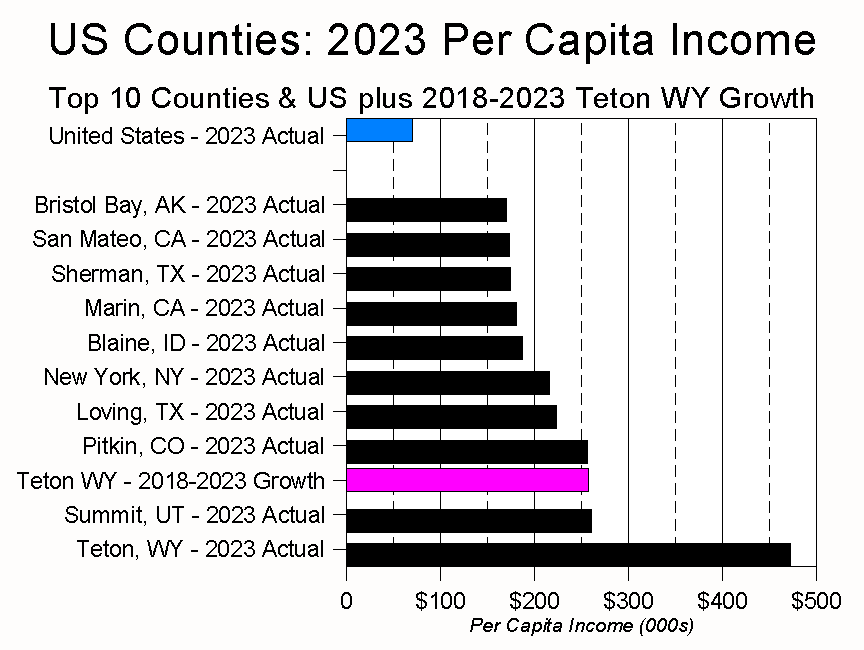
In 2018, Teton County’s nation-leading per capita income was $214,681. In 2023, our nation-leading per capita income was $471,751. This means that in five years, Teton County’s per capita income grew $257,070. Which, in turn, is a greater amount than the 2023 per capita income of all but one other US county. (Figure 1)
Such extraordinary growth is indicative of the dramatic change that has swept over Jackson Hole over the past 5-10 years. How to address such powerful forces? The place to start is by clearly identifying our values and priorities.
Question 1 asks us to affirm whether ecosystem health remains our paramount priority. Question 2 asks what else we value. Unfortunately, it’s been over a decade since Jackson Hole has had such discussions; i.e., we’ve not spoken about what matters to us since the current trends buffeting us really kicked into gear.
Such conversations are difficult. The longer we postpone them, though, the likelier it is that we’ll lose control over our destiny.
Question 3.
Champagne tastes; beer budget: What is the proper role of government?
Jackson Hole is a 21st century community with a 20th century operating system. Perhaps the clearest example of this is the large and growing disconnect between the local economy and how local government generates revenue.
For instance, since 2020, Teton County has sold essentially the same amount of taxable goods as it has real estate: $10.8 billion and $10.6 billion respectively. Yet we don’t tax real estate sales. Nor do we tax residents’ income which, in 2023 alone, totaled $11.0 billion.
Because of this 21st century/20th century disconnect, local government’s expenses are going up faster than its revenues. As a result, no matter how much government tightens its belt (which is the necessary next step), residents will soon need to choose one of two options:
- Keep the current tax structure
- Do this, and it means accepting fewer and/or lower-quality government services
- Keep the same level of local government services (or perhaps expand them)
- Do this, and it means paying higher taxes
To make this choice, we need to decide what role we want local government to play, what services we want it to provide, and the like. As with Questions 1 and 2, this question, too, requires a deep community-wide discussion.
Question 4.
Subsidizing local business: Whom shall we house?
As is the case with most other desirable places to live, Jackson Hole has affordable housing programs. Why? Because for developers, high-end homes are profitable and workforce housing is not.
Rarely mentioned in affordable housing discussions, though, is another reality: When the community provides affordable housing, we’re subsidizing the industries that can’t or won’t pay their employees enough to afford local housing.
This suggests the need for another conversation. Because we’ll never be able to build enough affordable housing for everyone who wants it, who should get the housing we do build? Should it be open to all comers? Should we prioritize essential service providers or some other cohort? Should government even be in the affordable housing game at all?
Which in turn leads into two larger conversations. One is practical: Given Jackson Hole’s resources – financial, human, legal, and other – what affordable housing efforts should we be making, and what expectations should we have for those efforts?
The other is existential: Looking out 10, 25, 50 years and more, what kind of community do we want to be? The affordable homes we build today will answer that question by determining who can live here in the future. Before we build those units, we need to be clear about not just who we want living in them, but why.
Question 5.
Gridlock: How much traffic are we willing to put up with?
Over the past decade, the traffic counts on Jackson Hole’s different roads have increased between 20%-55%. With the exception of the landslide-affected Highway 22/Teton Pass, 2024 was the busiest year in history for all of Jackson Hole’s major roads.
A daisy chain of causes underlies this growth.
It starts with Jackson Hole being both a tax haven and a very attractive place to live. Combined, these qualities have attracted a slew of new, wealthy residents and produced a booming economy. Which, in turn, has led to a job boom. Which, in turn, requires ever more workers.
Between the job boom and the newer, wealthier residents, demand for housing has risen, driving up prices. As that’s occurred, workers relying on local wages have been priced out of the Jackson Hole valley, leading them to move to Idaho or Star Valley. As that’s happened, they’ve become commuters. As that’s happened, traffic has soared.
This dynamic has led some people to advocate for building a lot more workforce housing in Jackson Hole. The logic of this argument is that if we build more homes, fewer people will need to commute. The only way this logic holds, though, is if job growth stops.
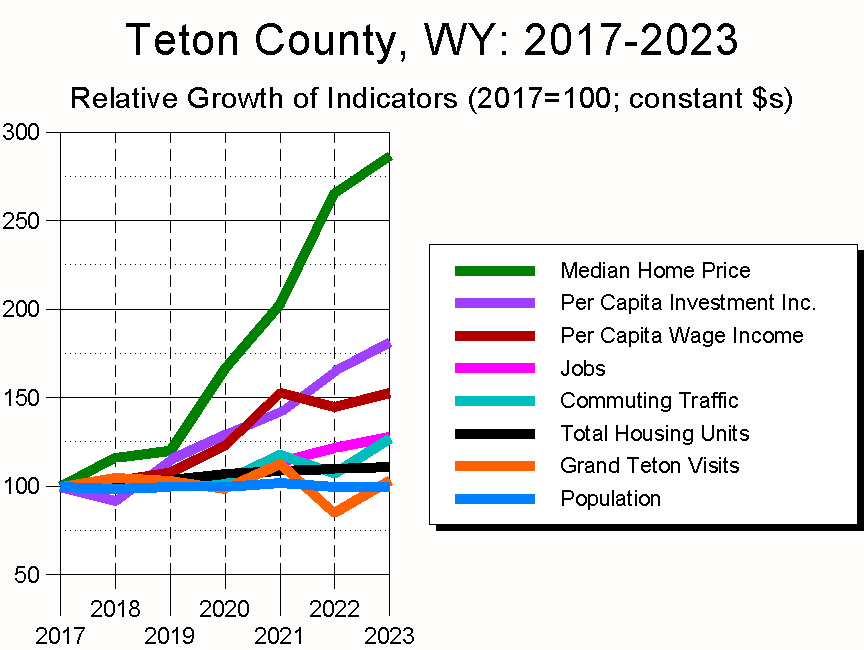
If it doesn’t – if a former commuter is replaced by a new commuter filling a new job – then traffic will get worse. Which is exactly what we’ve been seeing: Over the past several years, jobs and traffic have been growing pretty much in lockstep. (Figure 2)
As long as Jackson Hole continues to create more jobs and attract more visitors, our traffic problems will get worse. Which in turn means we need to ask ourselves yet another hard question: How much traffic are we willing to bear?
Comment
Recently, Jackson’s town council discussed what we do and how we do it.
During the conversation, I offered my belief that the council has just three roles:
- Do whatever is legally required of us by the state;
- Make policy; and
- Act as fiduciaries for the organization and community.
To me, acting as a fiduciary has two elements: financial and temporal. “Financial” means ensuring that the public’s money is spent wisely and well. “Temporal” means always being aware that the decisions we electeds make will affect Jackson for decades, if not centuries to come.
Arguably, this temporal perspective was easier to embrace when Jackson Hole’s geographic isolation limited the pace of growth and change – when a place is hard to get to, things don’t move too fast.
In the last generation, though, as technology has rendered geographic isolation increasingly moot, we’ve changed dramatically. No longer can a median income buy a median priced home. No longer do we aspire to reach 200,000 commercial airline enplanements (we’re now north of 550,000). No longer is being a UPS driver one of the few jobs in Jackson Hole that offers year-round employment and good benefits.
The list goes on, but the examples all point to the same conclusion: As we have become increasingly connected to the outside world, Jackson Hole has dramatically changed.
One thing that hasn’t changed is our inherent warmth and hospitality: We still embrace newcomers. Our mechanisms for teaching newcomers what it means to be a Jackson Holer, though, are increasingly unable to keep up with the socio-economic forces washing over us. Sadly, these forces are indifferent to the community’s people, character, and essence. And that leaves us increasingly vulnerable.
Rigorously asking and answering the five questions I pose above can provide a bulwark against the unrelenting forces of growth and change. What do you think? What are your answers? I’d love to know.
