
Hello, and happy snow day!
For the first time in over a month, Jackson Hole awoke this morning to fresh snow on the ground. No longer does early February feel like early May, with dry streets and bare lawns. Instead, there’s a welcome spring – or should I say “winter” – in the community’s collective step.
In other news of the week, two days ago was football’s Super Bowl. Five days ago was the data geek’s Super Bowl, the US Bureau of Economic Analysis’s annual release of a trove of county-level income data.
What I found was surprising but, for the most part, not shocking. For the 21st consecutive year, Teton County, Wyoming’s led the nation in per capita income (PCI): In 2024, our estimated PCI was $532,903.
Over half-a-million bucks. Over six times greater than the national average, and nearly twice the PCI of the second-place county.
In 2024, a staggering 77% of Teton County residents’ income came from investments, another nation-leading figure. And despite tourism being Teton County’s biggest employer, Jackson Hole’s biggest overall source of wages was location-neutral industries such finance and professional services.
Combine this with our investment income, and well over 80% of Teton County’s total income is location-neutral, another nation-leading figure.
Below, I expand on the numbers and offer a bit of commentary. I also begin to explore the consequences of all this wealth for Jackson Hole’s sense of community, which many people fear is being overwhelmed by the recent tidal wave of money.
I’ll continue this exploration in future CoThrives. Ditto my musings about whether to run again for office, which end today’s piece. Until then, I’ll go looking for Jackson Hole’s “average” half-million dollar resident to gauge his or her interest in supporting local non-profits which produce data-laden newsletters.
- $532.903
- Sources of Income
- Teton County v. The Nation
- Teton County v. Wyoming
- 2018-2024 Changes
- Comment
- Uses of Data
- Exceptionalism and Extraction
- Let’s Talk About Me
As always, thank you for your interest and support.

Jonathan Schechter
Executive Director
PS: It’s been a couple of months since my last CoThrive. Much of the reason was being gone on an extraordinary adventure to the South Atlantic and Antarctica (thanks so much Keith!).
Neither words nor photos can do justice to the grandeur of my experience. That noted, I took some great pictures while on the trip – I’ve scattered a few of them below.

$532.903
In 2024, Teton County, Wyoming’s per capita income was an estimated $532,903. This was the nation’s highest per capita income (PCI), 90% greater than that of second-place Summit County, Utah’s $280,510. (Summit County is the location of Park City.)
Teton WY’s 2024 PCI was more than six times higher than the national figure of $73,204, and over $500,000 – one-half-million dollars – higher than that of the county with America’s lowest PCI: Wheeler County, Georgia ($26,119).
In 2023, Teton WY’s PCI was $500,556, a figure revised upwards from last year’s original estimate of $471,751. Based on the revised figure, the 2023-2024 increase was 6.5%. Based on the original estimate, the 2023-2024 increase was twice that: 13.0%.
Sources of Income
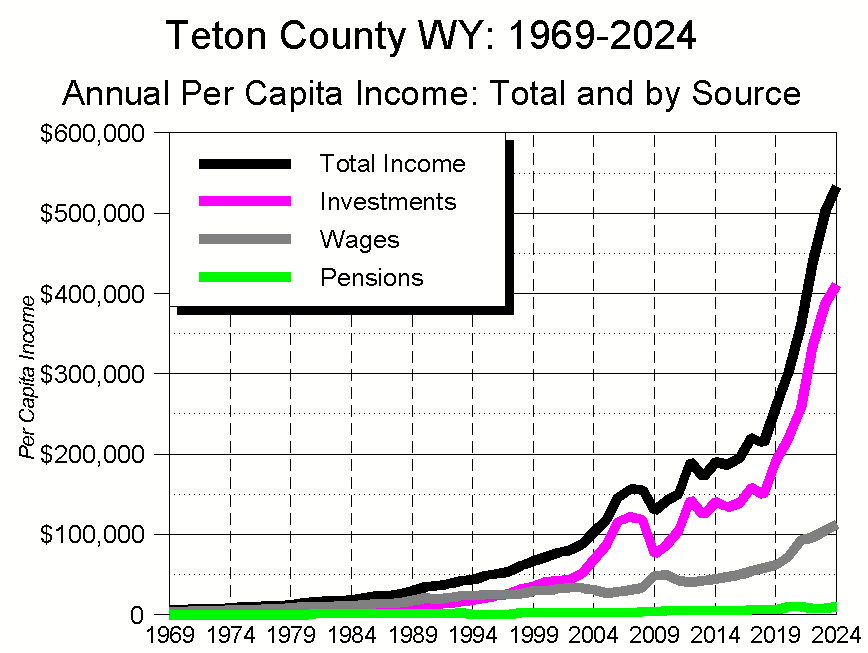
Investment income accounts for the majority of Teton WY residents’ income. In 2024, 77% of residents’ total income – $9.6 billion – came from investments, a per capita figure of $411,446.
In 2024, no other US county earned more than 68% of its income from investments; no other county had a per capita investment income figure of even $180,000.
Wages accounted for only 21% of residents’ total income in 2024. This percentage ranked Teton WY 3,114th out of America’s 3,116 counties. From a dollar perspective, though, Teton WY’s 2024 per capita wage income of $111,642 was the nation’s tenth-highest, putting Jackson Hole’s per capita wages on par with those in Silicon Valley.
Tourism employs more people than any other Jackson Hole industry. Despite this, in every year since the COVID pandemic the total wages earned by Jackson Hole residents working in location-neutral jobs (e.g., professional services and finance) have exceeded those earned by people working in tourism.
This is notable because, when added to residents’ investment income, in 2024 well over 80% of Teton WY residents’ total income was location-neutral, another nation-leading percentage. (Figure 1)
Teton County v. The Nation
As noted earlier, Teton WY’s 2024 PCI of $532,903 was easily the nation’s highest. How easily? The difference between Teton WY and second-place Summit UT, was $252,393, essentially the same amount as the $254,391 separating Summit UT and the county with America’s lowest PCI: Wheeler GA. (Figure 2)

Indeed, in 2024 Teton WY’s lead was so large that its per capita investment income alone was $131,000 higher – 47% – than Summit UT’s total PCI. (Figure 3)

To fully grasp the magnitude of Teton WY’s PCI, though, we need to stop being species-ist.
In 2024 the residents of Teton WY and Summit UT earned roughly the same amount of money: $12.4 billion for Teton WY and $12.1 billion for Summit UT.
Building on this, if we include in our PCI calculations not just Teton County’s human population, but all of the county’s dogs and all of the elk on the National Elk Refuge, (an estimated 10,000 and 6,700 respectively), in 2024 Teton WY’s resulting PCI still would have been higher than Summit UT’s all-human figure.
2024 marked the record-setting 21st consecutive year that Teton WY had the nation’s highest per capita income. Since 1969, only New York County, New York (the island of Manhattan) has come close to Teton WY’s record: It led the nation in 1969, and then again for 19 consecutive years from 1985-2003. Since 2004, though, Teton WY has had an ever-growing lead over the nation’s other 3,115 counties. (Figure 4)
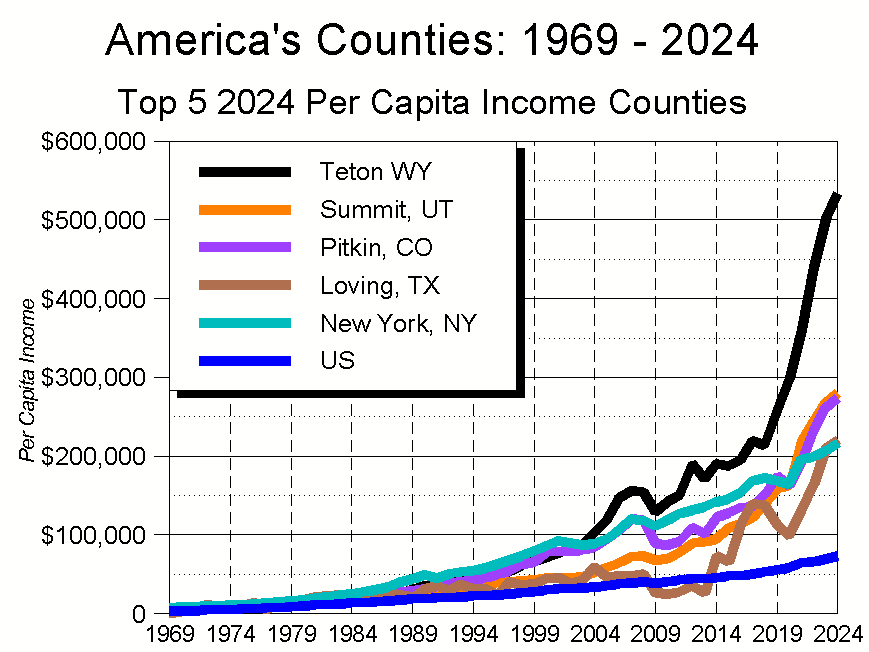
Also striking is that America’s three highest PCI counties are Rocky Mountain resort areas. So are four of the top six, and five of the top eleven. (Figure 5)

Teton County v. Wyoming
Over the past few decades, Wyoming has enacted a series of laws which, combined, have made the state arguably the most wealth-friendly in the nation.
Despite the fact that these laws apply equally in each of the state’s 23 counties, Teton County stands alone in the wealth of its residents.
In 2024, Teton County was home to 4% of Wyoming’s 587,618 residents. Combined, those 4% accounted for 24% of the Wyomingites’ total income, and fully half their investment income. As a result, Teton County’s 2024 PCI of $532,903 was over six times greater than Wyoming’s statewide PCI of $86,477. In fact, remove Teton County from the mix and Wyoming’s statewide PCI drops by over 20%, to $68,068.
These figures also meant that Teton County’s per capita investment income of $411,446 was nearly 13 times higher than Wyoming’s per capita investment income of $32,658. Remove Teton County from the mix, and Wyoming’s per capita investment income drops nearly in half, to $17,038. (Figure 6)

Perhaps more surprisingly, despite leading the state in both the number and percentage of relatively low-paying tourism jobs, Teton County also led Wyoming in per capita wage income – its $111,642 figure was nearly three times higher than the state’s overall $41,044.
Teton WY’s extraordinary wealth produces one other notable statistic: Teton County has such a large proportion of Wyoming’s total income that it’s the only county with a PCI greater than the statewide average. (Figure 7)

2018-2024 Changes
I was first elected to Jackson’s Town Council in 2018. That year, Teton County’s population was 23,156. In 2024, as I completed my sixth year in office, it was 23,272, an increase of 0.5%.
When I was elected, Teton WY’s nation-leading PCI was $214,496. Six years later, that figure had more-than-doubled, to $532,903. As a result, between 2018-2024 Teton WY led the nation in both the dollar amount and percentage of PCI growth: $318,417 and 148%, respectively.
To put such whiplash-inducing growth into perspective, during those same six years the nation’s PCI grew from $53,311 to $73,204, an increase of $19,893, or 37%.
Between 2018-2024, Teton WY’s nation-leading per capita investment income figure went from $149,473 to $411,446, an increase of 175%. For the nation as a whole, the figures were $10,518, $15,342, and 46%.
During that same stretch, Teton WY’s per capita wage income also exploded, nearly doubling from $58,532 to $111,642 (91%). As hinted at above, this explosion was led by a boom in location-neutral jobs and, especially, location-neutral wages. As a result, between 2018-2024, Teton WY’s per capita wage growth was three times greater than the US average, and ranked the county 28th nationally. (Figure 8)

Comment
My thoughts about Teton WY’s PCI fall into three categories: Uses of Data, Exceptionalism & Extraction, and Let’s Talk About Me.
Uses of Data
Over the years, I’ve come to think of myself as someone who uses data to tell stories. From this perspective, I use different types of data to tell different types of stories.
For example, while I find these new PCI figures jaw-dropping, a friend’s response was essentially a big shrug: “Tell me something I don’t know.”
To him there are a bunch of rich people in Jackson Hole, they’ve been here for quite a while, their numbers are growing, and so is their individual wealth. Since we can’t do anything about it, why waste time thinking about it? Instead, he urged me to get my mind out of the clouds and focus on something practical.
In a similar vein, another friend thinks it’s misleading to use per capita income data (i.e., residents’ mean or average income). “Averages are skewed by the really rich people living here. Instead, you should focus on median income. That’s the true measure of a community.”
Both objections have some merit. At a certain level, Jackson Hole’s average income doesn’t make much difference in the community’s day-to-day life. Similarly, in some circumstances, the median sheds more light than the mean.
To me, though, that’s not the point of this story. Instead, the PCI figures matter for two reasons: one symbolic; the other practical.
The symbolic importance of PCI lies in its power to distill the community’s great unease about where it is and where it’s going into one simple phrase: “Jackson Hole’s average income is over half-a-million dollars.”
Consider that for a moment. Jackson Hole’s population includes both skids and billionaires. People working three jobs and people owning three homes. A tapestry of folks encompassing a variety of ethnicities and beliefs and many other differences.
Despite all this, in 2024 every man, woman, and child living in Teton County made an average of $532,903. Over half-a-million bucks each.
I’m not one of those folks, and you probably aren’t either. But for the math to work, it has to be true for literally thousands of Jackson Hole residents.
From that perspective, what’s worrying a lot of “below average” people right now is whether they can continue to live in this place they love so much. And that’s where the practical power of figures like PCI comes in: Because PCI takes into account the extremes, it shines a bright light on things making people anxious.
For example, there’s a remarkably tight correlation between Jackson Hole’s housing prices and its PCI: For over two decades, each year’s mean housing price has been roughly 10 times higher than the community’s mean income. To me, that’s a handy tool for framing Jackson Hole’s affordable housing challenges. (Figure 9)

Similarly, PCI sheds a useful light on what I jokingly refer to as “The Jackson Hole Contagion.”
Since 2018, has Teton WY seen a huge increase in per capita total income and per capita investment income. So too have our neighbors: Teton County ID, and Lincoln County WY.
Specifically, out of America’s 3,116 counties, between 2018-2024 Lincoln WY and Teton WY ranked 26th and 30th nationally, respectively, in their percentage increases in per capita total income, and 10th and 16th, respectively, in their percentage increases in per capita investment income. For both good and ill, the changes washing over Jackson Hole are spilling over Teton Pass and running down the Snake River Canyon, arguably hitting our neighbors harder than us. (Figure 10)

In all these cases and more, the idea that the “typical” Jackson Hole resident is earning over half-a-million dollars per year is wildly discordant with many residents’ vision of their community. As such, the statistic both clarifies and lends urgency to the kinds of conversations we collectively need to have. (Figure 10)
Exceptionalism and Extraction
Here’s something Abraham Lincoln didn’t say, but is often attributed to him: “You cannot help the poor man by destroying the rich.”(Lincoln once said something similar, but the actual quote comes from the Rev. William J. H. Boetcker. The Lincoln mis-attribution was popularized by Ronald Reagan.)
This non-quote came to mind because of the staggering income differences between Teton County and the rest of Wyoming. As noted above, while having just four percent of Wyoming’s population, Teton County accounts for one-quarter of the state’s total income and one-half of its investment income. And this isn’t just because of a few wealthy people: Somewhere between 2,000 and 6,000 Teton WY residents live in households earning at least $1 million/year.
Which raises an interesting question: Why aren’t the wealthy flocking to Wyoming’s 22 other counties?
Travel around a bit and you quickly realize that Wyoming is filled with beautiful landscapes and wonderful communities. Yet the wealth is concentrated in Teton County, a fact that says something about both Teton County and the rest of the state.
To me, the fact that Wyoming’s wealth is not more evenly distributed is a tragedy. In my idealized world, the rest of Wyoming would learn from Teton County’s exceptionalism and apply the lessons statewide. At a minimum, they would celebrate our success and do what they could to encourage it.
Instead, far too many statewide efforts seem aimed at dragging us down. At making it harder to sustain our nation-leading economy. Deal with its consequences. Position ourselves for an even brighter future.
Boetcker would be appalled. So would Lincoln. So would Reagan.
A similar sort of “don’t mess up a good thing” concern lies closer to home: How do Jackson Hole’s recent arrivals view their new community? Are they here to enhance it or simply extract from it?
Historically, an essential element of Jackson Hole’s character has been its lack of class distinctions. For example, old-timers talked about attending church in Moose with John D. Rockefeller, Jr., the world’s wealthiest man. “When the collection plate came around, he’d leave 50 cents or a dollar, just like the rest of us.”
Today, though, Jackson Hole’s class and wealth distinctions are not just increasingly clear, but increasingly cultivated.
Like most things in life, this is neither all good nor all bad. For example, one huge positive is our charitable giving, hallmarked by one of the world’s most remarkable philanthropic efforts: Old Bill’s Fun Run.
On the negative side, though, the simple reality is that it takes far more to maintain a community than simply write big checks. Philanthropy is necessary, but it’s not sufficient – a community is more than money alone.
Today, as ever-increasing wealth pours into Jackson Hole, a series of simple questions take on increasing importance. What, exactly, is community? What is its relationship to wealth? What really matters, and how do we steward those qualities?
In short, do we want to leave Jackson Hole better than we found it? If so, how do we do it?
We can’t answer either question if they go unasked, and we won’t leave Jackson Hole better if we don’t actively try to do so.
Let’s Talk About Me
Ignoring my friend’s admonition to be practical, I’ve been giving a lot of thought to the juxtaposition between Jackson Hole’s wealth and my role as an elected official.
In particular, my seat on Jackson’s Town Council is up in November. As a result, by the end of May I need to make a decision about my political future. Do I run for a third term on the council? Run for a first term on the Teton County Commission? Not run at all?
During my seven years in office, I’ve become increasingly aware of the wealth-driven changes roiling Jackson Hole, as well as local government’s ability to affect those changes and/or their consequences.
Simply put, local government is far less powerful than people believe it is. Whether legally, financially, or in staffing, local government is surprisingly limited in what it can do. Critically, there’s much it can’t do, regardless of how much voters may want it to. Yet because people have nowhere else to turn, local government is increasingly being asked to do increasingly more things.
Further complicating matters is the fact that, in stressful times, people look to their institutions – government, churches, schools, and so many more – to provide order, stability, and a sense of normalcy. Making this difficult task even harder are the manifold efforts to question, attack, delegitimize, and dismantle the institutions undergirding our system.
In such an environment, the question I’m asking myself is “What’s the best use of my time, energy, and life force?” I know why I want to serve: To help Jackson Hole and other extraordinary places stay extraordinary. What I’m wrestling with, though, is how best to do so. In particular, how well being in office aligns with my “Why.” PCI and other data help frame the question. The challenge I face is finding the answer.

